
Nationwide legal representation for clients challenging immigration court decisions and deportation orders.
If You Lost Your Case At Immigration Court
We Can Help You Fight Back
Was your immigration court case denied?
Many individuals who contact our office after losing at immigration court feel frustrated and unsure what went wrong. That reaction is understandable.
Led by Harvard Law School graduate and immigration attorney Carlos Batara, our office focuses on identifying legal errors in immigration court decisions and presenting those issues through careful appellate analysis.
Under immigration law, a denial issued by an immigration judge may be challenged through an appeal, provided specific legal requirements and filing deadlines are met.
Immigration court rulings are based on law, evidence, and procedure. When any of these are applied incorrectly, you have the right to challenge the decision through an appeal. The purpose of an appeal is to determine whether the immigration judge committed errors that affected the outcome of your case.
Appeals of immigration court decisions are filed with the Board of Immigration Appeals. In an appeal, you cannot present new evidence or get a new trial. Instead, the Board reviews your claims to ascertain if the judge made the mistakes you allege in denying your case.
Like all human beings, judges make mistakes.
In your case, for example:
- Was important evidence overlooked or ignored by the Immigration Judge?
- Did the Judge fail to properly consider testimony from one of your witnesses?
- Or was an immigration court rule or procedure used against you in an unfair manner?
If these types of errors took place, you have the right to challenge the Immigration Judge’s decision.
To do so, you usually need to file an appeal with the Board of Immigration Appeals. But immigration deportation appeals are no ordinary challenge.
Important Deadline Warning: In most immigration court cases, you have only 30 days from the immigration judge’s decision to begin the appeals process. Missing that deadline could eliminate your ability to challenge the ruling.
Let’s go over the details you need to know.
Table Of Contents
- What Is An Immigration Appeal?
- Why You Must Win Your Immigration Appeal To Prevent Deportation
- How Filing An Appeal Works
- What Is A Notice of Appeal?
- All Deportation Appeals Are Difficult Cases
- What Are The Chances Of Winning Immigration Appeals?
- High Stakes: Immigration Appeals We Have Handled
- Motions To Reopen And Reconsider: Alternatives To Appeals
- What If You Lose Your BIA Appeal?
- Federal Court Review After Adverse BIA Decision
- Your Immigration Appeal Requires Personalized Strategy
- Your Immigration Appeal Requires Specialized Training
- Pitfalls To Avoid: Factors Affecting Immigration Appeals Success
- Charting Your Course: Why Choosing The Right Immigration Appeals Lawyer Is Crucial
- Your Immigration Attorney’s Experience
- Your Immigration Attorney’s Writing Skills
- Your Immigration Attorney’s Dedication And Commitment
- Frequently Asked Questions About Immigration Appeals
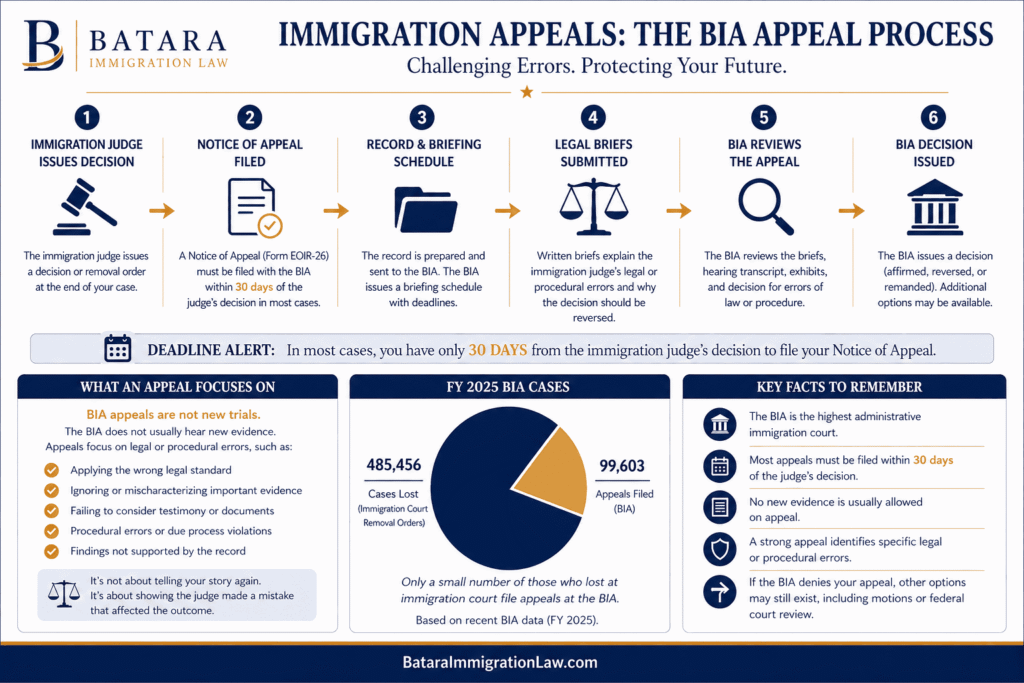
Immigration Court Appeal Process (Step-by-Step Overview)
While every case is different, most immigration court appeals follow this general process:
1. The immigration judge issues a decision or removal order
2. A Notice of Appeal is filed with the Board of Immigration Appeals
3. Written legal briefs are prepared, explaining the immigration judge’s decision and alleged mistakes, and submitted to the BIA
4. The BIA reviews the briefs and the court records for errors of law or procedure
5. The BIA issues a decision granting or denying the appeal
6. Additional options may exist, including motions or federal court review
What Is An Immigration Appeal?
An appeal, generally speaking, is a challenge to a previous decision. In particular, it is a challenge by a person who lost their case. They seek to undo and reverse the adverse judgment.
Appeals are filed with higher courts, known as appellate courts.
Immigration appeals are challenges to negative rulings by the Immigration Court (EOIR) or an immigration agency like the U.S. Citizenship and Immigration Services (USCIS).
In this article, we will focus on appeals that arise out of Immigration Court.
These are appeals filed with the Board of Immigration Appeals (BIA).
Considering An Immigration Court Appeal?
Being told your case is over can feel final. In some cases it is. In others, careful review reveals issues that deserve a second look.
Appeals to the Board of Immigration Appeals are governed by strict deadlines and legal standards. A brief review of an immigration judge’s decision may help determine whether an appeal is available and what issues can be raised.
We represent individuals and families in immigration court appeals nationwide. From our Hemet headquarters, we serve clients throughout Riverside County and San Bernardino County, and also provide virtual representation across California and the United States.
Contact our office to evaluate whether an appeal is appropriate.
Why You Must Win Your Immigration Appeal To Prevent Deportation And Separation
Once you lose your case at Immigration Court, the government can remove you from the United States.
If you file a BIA deportation defense appeal, doors remain temporarily open. The government will not take steps to deport you until your immigration appeal is over.
This is called a “stay” of deporation – a temporary suspension of the order to remove a person from the United States.
Your hopes of living, working, and going to school in the United States remain alive.
The opportunity to become or remain a lawful permanent resident will close, perhaps forever, if you lose your appeal. So winning your immigration appeal could be your last chance to stay together with your family in the United States.
In some cases, especially when the immigrant spouse is locked up at a detention center, the U.S. citizen husband or wife must take the lead in fighting back.
Take Camilla.
Like many wives who contact our office, she was not willing to give up on her husband without contesting the immigration judge’s decision to deport him:
“I don’t think my husband received a fair trial, and that, among other things, is one of the main reasons I haven’t given up on this case. Do I think his due process rights were violated? Yes I do.
The judge did not combine hardships. My daughter has a complicated medical history. But the judge said he was not considering my daughter’s health care a hardship to my current husband because my ex-husband is involved in her life on the weekends. We have split custody, that’s true, but my ex-husband is not living with me.
My daughter is a special needs child and taking care of her is a big, big responsibility, especially with my own health issues, and two other minor children. Even though my husband is a wonderful step-father, his role in their upbringing was ignored.
The judge also said my husband’s personal testimony was weak. He is a very intelligent person, but I don’t think he was able to represent himself very well in court. He said that his translator spoke a different dialect and it made some things hard to understand. Yet, the judge let the case go forward.
My husband has a difficult time talking to people he doesn’t know, and he comes across as very withdrawn. He rarely makes eye contact. I personally think he suffers from severe social anxiety disorder and while he was in jail, there was psychological testing done. The judge did not allow further testing, because he said there was no time for that.
I need my husband. My children need their step-father. I want to fight my husband’s case.”
How Filing An Appeal Works
Winning your appeal is not easy.
It is more difficult, in many ways, than winning your trial at immigration court.
A BIA appeal, after all, is not a retrial. It is a review regarding what happened at court, and whether legal errors were made that led to the negative outcome.
Moreover, most immigration appeals are “paper” appeals. Witnesses do not testify. Lawyers do not appear in court.
Nor can you ask the BIA to second-guess issues that are properly within the immigration judge’s discretionary authority.
There must be a concrete mistake.
In almost all appeals I have handled, the critical question was not whether the outcome was unfavorable, but whether the judge’s reasoning contained a legal or procedural flaw that could be challenged and reversed.
What Is A Notice of Appeal?
The Notice of Appeal is a short document filed with the Board of Immigration Appeals which informs the Immigration Court and Department of Homeland Security that you are challenging the court’s decision.
Filing a Notice of Appeal starts the appeals process. It is required to be filed in Falls Church, Virginia within 30 days of the Immigration Judge’s decision in your case.
The Board of Immigration Appeals (BIA) is the nation’s highest immigration court.
When filing an appeal with the BIA, don’t fall into the trap of thinking their role is to re-weigh all the evidence presented.
Rather, their review is more limited and frequently less immigrant-friendly than decisions by immigration judges.
Quite often the issues from the immigration court hearings you think are important – are not relevant to the Board of Immigration Appeals.
And this is one crucial reason you likely need the guidance and help of an immigration appeals attorney. You want to make sure that the issues you present are properly and thoroughly developed.
A Notice of Appeal is not simply a formality. The issues identified at that stage can and do shape how the entire appeal is reviewed.
Denied in Immigration Court? Time Matters.
If you or a loved one has received an adverse immigration court decision, the window to act is extremely short. A careful review of the judge’s ruling may determine whether an appeal is possible and what issues can be raised.
Contact Batara Immigration Law to evaluate your immigration appeal options before critical deadlines expire.
All Deportation Appeals Are Difficult Cases
Immigration Court appeals are a special component of deportation defense.
Because of highly technical rules and procedures, helping clients fight their appeals is one of the most arduous responsibilities of deportation and removal defense services – and the most important for immigrants who have already lost their cases.
What Are The Chances Of Winning Immigration Appeals?
Each year, hundreds of thousands of immigrants lose cases in immigration court. Only a fraction take it to the next level. Fewer win.
According to recent data from the immigration court, in FY 2025, judges issued 485,456 removal orders nationwide. During this period, 99,603 appeals were filed with the BIA. This means only about 17% of those who lost at immigration court continued through the BIA appellate process.
Of the 17% who went forward, the number of persons who won their appeals is unknown. Statistical reports published by government agencies do not indicate how many individuals ultimately prevailed.
What is clear, however, is that many immigrants never appeal at all.
Some are discouraged by family and friends. Some miss deadlines. Some cannot afford the cost. Others believe nothing more can be done.
Yet, in many cases, an appeal is an immigrant’s last chance to challenge a wrong decision and protect their family’s future..
Even though immigration appeals are demanding, they are not without hope. .
When legal or procedural errors occurred, a thoroughly prepared appeal can keep families together.
Immigration Appeals Require Strategic Issue Selection
Because the chances of success are often low, winning an immigration appeal usually depends on identifying the strongest legal errors and presenting them through careful appellate briefing.
Over the years, I have seen appeals fail because too many weak issues were raised, while stronger arguments were buried. Successful appellate challenges require careful issue selection and focused argument.
If you are considering an appeal, experienced legal analysis may be the difference between removal and staying with your family in the United States.
High Stakes Immigration Appeals
We Have Handled
BIA Appeal Based On The Immigration Judge Ignoring An Available Defense
In a California case, a lawful permanent resident lost his case in immigration court despite qualifying for two types of relief from deportation: cancellation of removal and relief under INA § 212(h). The immigration judge only considered cancellation of removal, viewing it as the simpler option, and declined to evaluate the § 212(h) claim.
Cancellation of removal for lawful permanent residents does not require proof that a qualifying relative would suffer extreme hardship if the individual is deported. Instead, the judge weighs positive and negative equities, such as family ties, length of residence, and criminal history. For that reason, the judge viewed cancellation of removal as the easier path.
The judge reasoned because § 212(h) relief requires a showing of extreme hardship to a qualifying relative, such as a spouse, child, or parent, it involves a tougher legal standard. As a result, the judge declined to pursue a § 212(h) analysis. He overlooked that § 212(h) relief involves more than hardship to qualifying relatives. The statute also requires a full consideration of the permanent resident’s own hardship..
In this case, the individual’s personal hardship was substantial and should have been considered as part of the § 212(h) analysis. By cutting off review of that claim, the judge excluded a major factor in the client’s favor. On appeal, we challenged this omission and the failure to properly consider all available relief. The Board of Immigration Appeals agreed and held that the judge’s analysis was incomplete.
BIA Appeal Involving Family Unity And Relocation Issues
In a case arising out of Texas, a husband and wife with three U.S.-born children were placed in immigration proceedings. The wife’s case was heard first. The immigration judge ordered her removed to Mexico. He assumed the husband, a native of Guatemala, could relocate there and the family could remain together, Based on that assumption, the judge minimized the impact of family separation and did not fully evaluate how the wife’s removal would affect the children.
At a later hearing, the same judge ordered the husband removed to Guatemala. This ruling showed the earlier assumption about the family relocating together to Mexico was speculative and incorrect. The government did not provide any evidence regarding the immigration process in Mexico for the husband or children to join the wife. Nor did it offer information whether the wife and children could immigrate to Guatemala.
On appeal, we argued the judge’s unsupported conjectures precluded proper consideration of the relocation issue. Since their parents were ordered deported to different countries, the children would have to leave the United States, as well as face separation from at least one parent.
BIA Appeal Challenging How Cancellation Of Removal And Qualifying Relatives Were Evaluated
A family of five from the State of Washington contacted us after losing a joint immigration court case. The parents and their three children had entered the U.S. without permission more than ten years earlier. At the time of the hearing, the children ranged in age from 17 to 20, and the parents also had an eight-year-old child born in the United States. All family members lived in the same home.
At the hearing, the parents sought cancellation of removal under INA § 240A(b) and presented evidence of the hardship their children would face if the parents were deported. The immigration judge declined to separate the cases, so only the eight-year-old U.S. citizen child was considered a qualifying relative for hardship purposes.
On appeal, we argued that the court erred by failing to separate the cases of the three older children. The two oldest children were married with children of their own, and the 17-year-old also had a young child born in the United States. Each of the three older children was entitled to an individual cancellation of removal hearing. This meant their children’s hardships would count as qualifying relatives in their individual cases. The Board of Immigration Appeals agreed and sent the cases back for new hearings.
Motions to Reopen and Reconsider: Alternatives to Immigration Court Appeals
After an immigration court hearing has ended, immigrants have the right to challenge a judge’s decision to deny them relief and order their deportation. The most common route is to file an immigration appeal.
However, filing an appeal is not always the best approach. In some cases, your situation would be better served by filing a motion to reopen or a motion to reconsider.
Motions to reopen are based on new evidence or changed circumstances that were not available at the time of the hearing. Motions to reconsider focus on a misapplication of law, policy, or procedure by the immigration judge.
Often, the two motions can be combined.
For a more detailed explanation of how these motions work and when they apply, see our page on Immigration Court motions to reopen and reconsider.

What If You Lose Your BIA Appeal?
If you lose your BIA appeal, once again your case is over. You are required to leave the country or immigration agents will begin the deportation process on their own.
In some cases, if you lose your case before the BIA, you can file another appeal with a higher court – the Federal Circuit Court of Appeals.
Federal Court Review After BIA Decision
As you move from one court to a higher court, the rules for contesting a decision becomes narrower and narrower, stricter and stricter.
Issues not preserved at earlier stages cannot be considered later. That is why appellate strategy must be forward-looking from the beginning.
Federal appeals have separate procedures, filing deadlines, and mors omplex court rules. In addition, they focus on the decisions made by the Board of Immigration Appeals.
This means some issues which were important to present to the Board of Immigration Appeals – are not relevant to the federal appellate court.
Yet, filing an appeal at federal court is sometimes the only way to win your case – especially if your case involves unique issues or new laws just passed by Congress.
However, filing a higher court appeal does not automatically prevent your removal from the U.S. A special motion to stay the deportation is usually required.
Although overcoming the immigration judge’s decision remains possible, the odds for winning are much lower.
Yepez-Razo v. Gonzales
In 1987, at age 11, Miriam entered the U.S. under the family unity provisions created by the Reagan Administration. She was allowed to live here while the government reviewed her application for lawful permanent residency. Her father was required to renew her status every two years until a final decision was made.
In 1995, Miriam’s father filed her papers about two weeks late. The government approved the extension.
In 1996, she was granted lawful permanent resident status.
In 1998, Miriam was arrested for a minor offense. She was turned over to immigration agents and immediately scheduled for deportation hearings.
Before calling our immigration law offices, Miriam’s father and husband were told by other immigration attorneys that she did not qualify for any relief. They came to our San Diego office barely two hours before her hearing was scheduled to begin. Carlos identified one – and only one – way to fight her deportation.
- For Miriam’s husband, a U.S. citizen, deportation meant losing his wife and the mother of their newborn child, and the end of their life together.
- For Miriam’s father, deportation meant losing his only child as a result of a simple filing mistake he made several years ago.
- For Miriam, deportation meant being forced to leave the only country she had known since she was in pre-school, having to lose her job, her home, and her friends, as well as being separated form her father, her daughter, and husband.
They decided to go with Carlos’ recommendation. They understood the fight would be complicated.
Under the new rules, the government argued, Miriam needed seven years of lawful permanent resident status before the date she was arrested. This meant she was disqualified from any defense and would be deported.
Carlos disputed the government’s position. He argued for a different interpretation of the new law. He asserted the new law only mandated seven years of lawful presence. Because the government allowed her to remain in the United States since 1987, he explained, Miriam’s presence was lawful.
The Immigration Judge agreed with the government. The judge ordered her to be deported.
Carlos filed an appeal with the Board of Immigration Appeals. He challenged the government’s position and the judge’s decision.
Three years later, the BIA ruled against Miriam. Carlos firmly believed they were wrong. He refused to quit. Miriam’s family refused to quit. They took their challenge to the Ninth Circuit Court of Appeals.
Finally, after four more years, Miriam won her appeal. Her case lasted over eight years.
The nightmare was over.
Your Immigration Appeal Requires Personalized Strategy
If you have lost your case at immigration court, and you need to file an appeal, a lot is at stake for you and your family.
Your immigration appeals attorney cannot afford to take a “one size fits all” cookie-cutter approach to your appeal.
Every immigration appeal is different.
No two cases are exactly alike. No two appeals are exactly alike.
Whether your case begins in Hemet, Riverside, San Bernardino, San Diego, Escondido or Riverside . . . or anywhere in the United States . . . your immigration lawyer must take an open-minded approach to finding solutions which increase your chances for success.
All of your immigration appeals attorney’s strategic decisions – from which pieces of evidence to highlight – to what aspects of the judge’s ruling to attack – are important to the final outcome of your appeal.
And they are never the same from case to case.
“I was trained to analyze a case from all angles. I was told to successfully confront my opponent, I must learn to think like my opponent. As a lawyer, this ability has been a tremendous asset in helping clients. When I work on appeals, I go inside a judge’s brain and explore logical flaws in his or her reasoning.”
— Carlos Batara
Your Immigration Appeal Requires Specialized Training
Few deportation appeals succeed without an immigration attorney who has a track record of handling appeals.
- Meet tight deadlines. Once you lose your case at Immigration Court, you have 30 days to file a Notice of Appeal. A few months later, you get a new deadline: your written appeal must be submitted in just 21 days. Your immigration lawyer must be ready to quickly act with thoroughness and accuracy.
- Understand appellate procedures. The Board of Immigration Appeals is allowed to make decisions on a “streamlined basis.” This means your immigration appeals lawyer has to get the facts and arguments in front of the appeals judge – and explain them clearly and persuasively the first time. There is no room for mistakes.
- Preserve options for higher appeals. If you lose your appeal with the Board of Immigration Appeals, you have the right to file an appeal with the Federal Court of Appeals, a higher court. You cannot afford errors on your BIA appeal – or you might damage your chance to win a federal court appeal. Only 1 in 10 BIA appeals succeed. Your immigration attorney must preserve all your options.
Pitfalls To Avoid: Factors That Can Undermine Immigration Appeals
Because appellate law is complex, there are various stumbling blocks which can trip up immigrants. Even strong cases can fall short. These articles discuss some of the toughest pitfalls and systemic challenges that present formidable hurdles to surmount.
How Lozada Motions Protect Immigrants At Immigration Court
Explains how ineffective assistance of counsel claims can arise in immigration appeals.
Immigration Appeals: 49 Minutes For Justice, Fairness, And Due Process
Discusses how time pressures and procedural constraints affect comprehensive BIA review.
Affirmance Without Opinion: BIA Cure Worse Than Appellate Disease
An analysis of streamlined BIA decision process and its impact on meaningful appellate analysis.
Dark Days Of Deportation Defense: The BIA Failure To Lead
Examines shortcomings with judicial issues like hardship within the immigration appellate system and their consequences.
Charting Your Course: Why Choosing The Right Immigration Appeals Lawyer Is Crucial
Your Immigration Attorney’s Experience
Immigration deportation appeals usually require a challenge to the immigration judge’s legal reasoning – a claim that the judge has not interpreted the law correctly. Perhaps the judge ignored testimony or overlooked evidence that was important to your case.This evidence may have led to a different decision.
Carlos Batara has been specializing in immigration law and immigration court appeals for over 30 years. He has acquired an in-depth knowledge of immigration rules and procedures, deportation defense, and immigration trials throughout the United States.
Your Immigration Attorney’s Writing Skills
Your immigration deportation appeal will succeed or fail based on the documents prepared on your behalf. Your immigration appeals lawyer needs to write persuasively, reason analytically, and identify creative but logical interpretations of immigration regulations.
A Harvard Law School graduate, Carlos Batara developed these skills at one of the top law schools in the United States – where precise writing, rigorous logic, and insightful argumentation were emphasized.
Your Immigration Attorney’s Dedication And Commitment
Generally, an appeal takes three to four times as long to prepare as family and employment petitions.
Appellate defense against removal is complicated.
There are no easy appeals. Reversing a deportation order and transforming it into a green card and permanent residency is not a task for the faint-hearted.
- Your immigration attorney’s location is not important. Immigration appeals presented to the Board of Immigration Appeals are almost always done entirely on paper. They are rarely made in person.
- We can work on your appeal whether you live in Sarasota or Seattle . . . Los Angeles or New York . . . or anywhere in the United States.
Your deportation appeal could last several years. Like swimming the English Channel against cold, choppy water and strong winds, a successful finish often appears beyond reach.
Your immigration deportation lawyer must be highly motivated to stay with you through what can be a long, frustrating process.
When it comes to immigration law, there are some cases where an attorney’s experience and skills alone are not enough. Winning a hard immigration appeal is one.
Dedication and commitment, at such times, is the difference.
If you are prepared to examine your immigration court decision carefully and explore whether legal errors were made, we invite you to schedule a strategy and planning consultation.
Appeals are not about re-arguing the case — they are about identifying factual or legal mistakes. A detailed review of your court decision is the first step.
Timing Matters In Immigration Appeals: Why You May Need To Act Now
Immigration appeals are governed by strict deadlines and procedural rules. In most cases, you have only a short window to file a Notice of Appeal after an immigration judge issues a decision.
Delays can do more than postpone your case. Missing a deadline may eliminate your ability to challenge the ruling altogether, while waiting too long to evaluate your options can limit the arguments that can be raised on appeal. Early review of the immigration court’s decision helps ensure that potential legal errors are properly identified and preserved.
Taking The Next Step In Your Immigration Appeals Case
If you have received an adverse decision at immigration court, the next step is to determine whether an appeal or post-decision motion is available in your case.
A careful review of the judge’s ruling, the hearing record, and the legal issues involved can help identify whether errors occurred and how they may be challenged.
Because appellate deadlines are short and the process is highly technical, timely evaluation is essential.
Speaking with an experienced immigration appeals attorney can help you assess your situation, understand your options, and decide how best to proceed.
Additional Immigration Services
For an overview of all immigration matters we handle, in addition to our immigration appeals services, visit our Immigration Legal Services page.
Frequently Asked Questions About Immigration Appeals
How long do I have to appeal an immigration court decision?
In most cases, you must file a Notice of Appeal with the Board of Immigration Appeals within 30 days of the immigration judge’s decision. Acting quickly is critical because missing the deadline may eliminate your right to appeal.
Can I stay in the United States while my appeal is pending?
In most situations, filing an appeal will temporarily pause removal while the case is reviewed. In addition, the payment of a bond may be required.
Can I submit new evidence in a BIA appeal?
No. Immigration appeals are generally not new trials. The BIA reviews the existing court record to determine whether the immigration judge made errors of law or procedure.
What is the difference between an appeal and a motion to reopen?
An appeal challenges legal or procedural mistakes in the judge’s decision. A motion to reopen may be available when new evidence or changed circumstances arise after the decision.
What happens if I lose my appeal at the BIA?
If the BIA denies your appeal, additional options may still exist. You may be able to file motions with the BIA or an appeal in federal court. A federal court appeal challenges the BIA decision.
How long do immigration appeals usually take?
Most appeals take several months. Often, they take a year or longer, depending on the complexity of the case, and the BIA’s caseload.
Do I need a lawyer for an immigration appeal?
Technically speaking, no. However, immigration appeals involve highly technical legal standards and strong appellate advocacy. Because appeals are not simply re-arguments of the case, experienced representation is often essential.
What should I do immediately after losing my immigration court case?
You should consult with an immigration appeals attorney as soon as possible so that your decision can be reviewed and legal deadlines can be protected. When you filed the Notice of Appeal, you want to point out the main points you plan to raised in your appellate arguments.
Reviewed by Carlos Batara, Immigration Appeals Attorney
Serving clients through our Hemet headquarters, throughout Riverside County and San Bernardino County, and nationwide through virtual representation.
Last updated: May 2026
Immigration Appeals Assistance Throughout Hemet, San Bernardino County, And Riverside County
A denial from the immigration court is not always the end of the road.
If an immigration court ruled against you, you may still have options. Appeals and post-decision motions may be possible. They can challenge incorrect decisions and protect your future.
These cases demand precision. Success requires detailed legal analysis, procedural expertise, and persuasive written advocacy..
We can handle your immigration appeals and help you fight for a second chance through any of our regional service hubs:
No matter where you live, we are committed to protecting your rights, pursuing every form of relief available, and keeping your family together.
Nationwide Representation: Immigration appeals are done through written submissions. Because of this, representation does not depend on an attorney’s physical location. Our virtual immigration law office enables us to prepare and file immigration appeals for clients anywhere in the U.S. This means we can help individuals and families no matter where they live.
If you lost your case, you refuse to give up, and you’re ready to explore whether to file an immigration appeal, let’s schedule your personalized strategy and planning session.