Children are often the heart of their immigrant parents’ hardship cases. Not because the law compels it. But because few things speak more directly to the human cost of removal or separation than the suffering of the children involved.
This article is not about the hardship of immigrant parents. It is about the hardship of their children — and how documenting that hardship, across twelve aspects of a child’s life, can become the most decisive evidence in a parent’s fight to stay.
For an immigrant facing deportation or seeking permission to enter the United States, everything can turn on a single legal question: can the immigrant’s family demonstrate sufficient hardship to merit the government’s leniency?
In case after case, the answer to that question depends on how severely the immigrant’s children will suffer if their parent loses their case.
This article is written for a typical family that appears in immigration courtrooms and USCIS offices every day.
The family consists of an immigrant spouse, a U.S. citizen or lawful permanent resident (LPR) spouse, and at least one U.S. citizen or lawful permanent resident child.
This type of family, where some members are United States citizens or lawful permanent residents, while others are still seeking legal status, is commonly referred to as a mixed-status family.
Table Of Contents
- What Must You Prove In An Immigration Hardship Case?
- Why Children Matter In Hardship Cases
- Who Are The Qualifying Relatives And What Hardship Standards Apply?
- Can Children’s Hardships Count When They Are Not Qualifying Relatives?
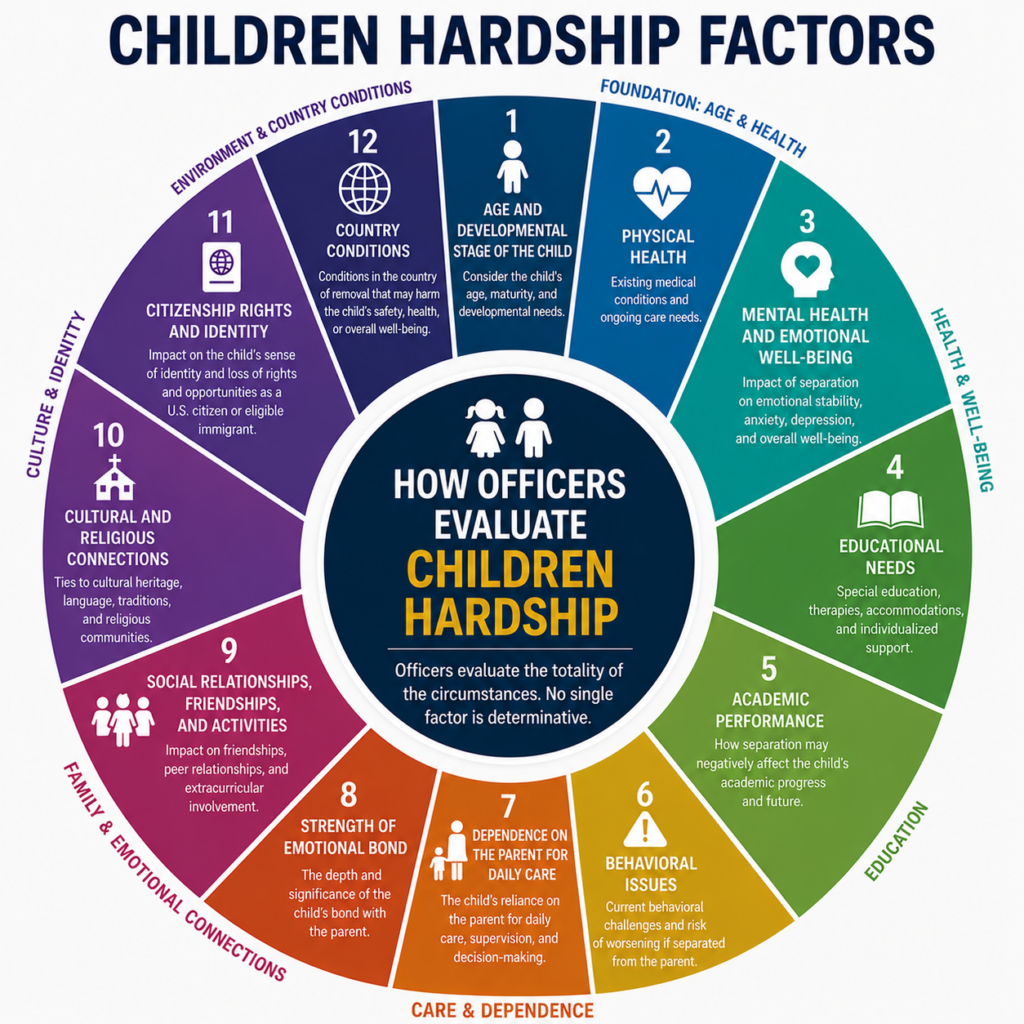
- What Children’s Hardship Factors Should You Consider?
- Age And Developmental Stage Of The Child
- Physical Health
- Mental Health And Emotional Well-Being
- Educational Needs
- Academic Performance
- Behavioral Issues
- Dependence On The Parent For Daily Care
- Strength Of Emotional Bond
- Social Relationships, Friendships, And Activities
- Cultural And Religious Connections
- Citizenship Rights And Identity
- Country Conditions
- The Back Door: A Two-Layer Approach To Children’s Hardship
- From Pebbles To Boulders: Building The Case One Child At A Time
- Writing The Hardship Narrative: The Power Of Specificity
- The Totality Of The Circumstances
- Children: The Heart Of Hardship
What Must You Prove In An Immigration Hardship Case?
When the immigrant parent in a mixed-status faces removal or seeks a waiver, the law demands proof that certain family members, known as qualifying relatives, will experience a defined degree of hardship if the immigrant is removed or denied entry.
If that hardship is proven, the immigrant may be allowed to remain in or enter the United States. If it is not proven, the immigrant loses, leaving the family to confront an agonizing choice.
The choice is based on two distinct options: separation or relocation.
In the first scenario, the immigrant is removed or denied entry while the U.S. citizen or lawful permanent resident spouse and children remain in the United States, enduring the hardship of family separation. In the second scenario, the spouse and children uproot their lives and relocate abroad to remain with the immigrant, trading the hardship of separation for the hardship of life in a foreign country.
The evidence in each scenario is different. A thorough case addresses both.
Why Children Matter In Hardship Cases
Children count. Even when they are not qualifying relatives, their hardships are often the most decisive factor in their parents’ cases.
The reason is partly legal and partly human. After all, many immigration officers and judges are parents too. And even those who are not, understand the importance of a parent in a child’s life.
A well-documented hardship case places a real child at the center of the narrative. A child with a name, a classroom, a best friend, and a parent who braids her hair every morning. Children are not footnotes to proving extreme hardship.
In this article, three of the most consequential immigration relief options available to families in hardship cases will be explored: the I-601 Waiver, the I-601A Waiver, and Cancellation of Removal. Each requires proof that if the immigrant parent is deported or not allowed entry into the country, a qualifying relative will suffer hardship well beyond the ordinary pain of family separation.
The goal is to help you think comprehensively about every facet of your child’s life that can become evidence of their hardship.
Although every issue will rarely apply to a child, presenting as many as do apply will help build the most complete and persuasive hardship case possible.
Led by Harvard Law School graduate and immigration attorney Carlos Batara, our office has spent more than 30 years helping immigrant families document and prove hardship in complex immigration cases, including I-601 waivers, I-601A waivers, and Cancellation of Removal proceedings.
Who Are The Qualifying Relatives And What Hardship Standards Apply?
Not every family member’s hardship counts equally under immigration law. The law specifies whose hardship matters. Identifying your qualifying relatives is one of the first steps in all hardship cases.
For the mixed-status family at the center of this article – an immigrant spouse, a U.S. citizen or lawful permanent resident spouse, and at least one U.S. citizen or lawful permanent resident child – the qualifying relatives are as follows.
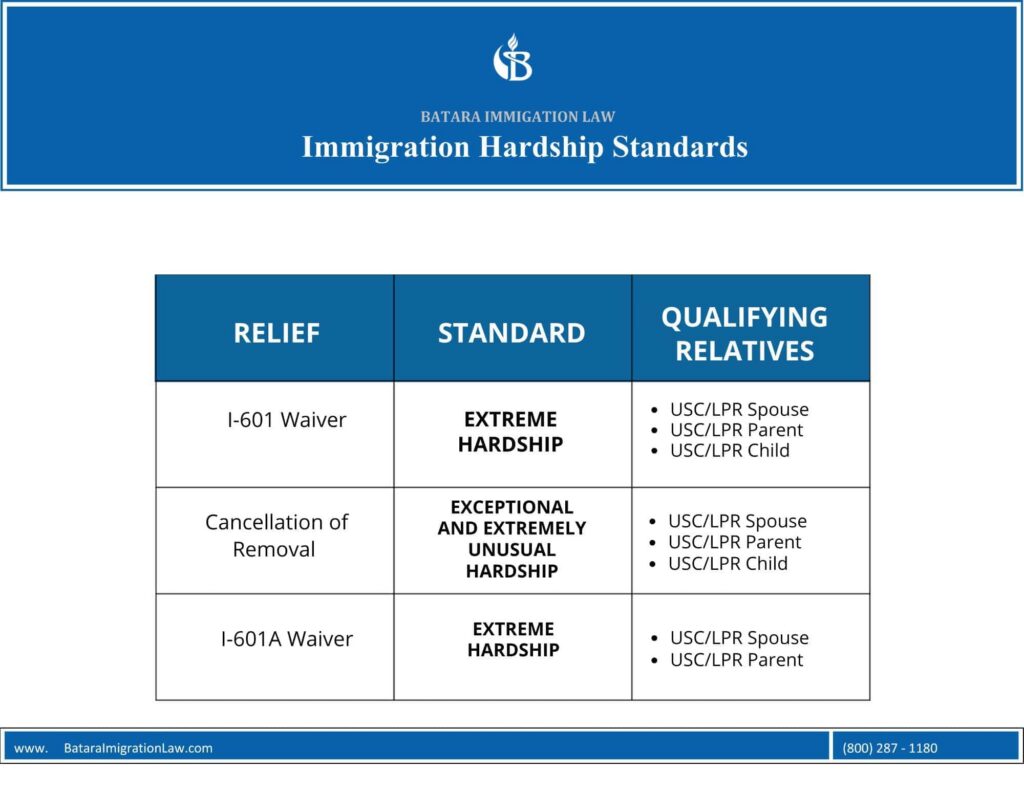
Under the I-601 Waiver, qualifying relatives include a U.S. citizen or lawful permanent resident (LPR) spouse, parent, or child of the immigrant. Both the spouse’s and the child’s hardships count directly and stand on their own in the legal analysis.
Under the I-601A Waiver, qualifying relatives are limited to a U.S. citizen or LPR spouse or parent only. Children, even U.S. citizen children, do not count as qualifying relatives. Nonetheless, their hardships, presented correctly, remain powerful indirect evidence through their impact on the qualifying spouse.
Under Cancellation of Removal, qualifying relatives include a U.S. citizen or LPR spouse, parent, or child of the immigrant. As with I-601 waivers, both the spouse’s hardship and the child’s hardship count directly.
In addition, the degree of hardship that must be demonstrated differs across the three relief frameworks.
The I-601 and I-601A Waivers require proof of extreme hardship — hardship that goes substantially beyond the ordinary consequences of family separation.
Cancellation of Removal applies the standard of exceptional and extremely unusual hardship — hardship substantially beyond what ordinarily accompanies removal.
In practice, the difference between the two standards is less significant than it might appear. In both cases, the key is the same: thorough, specific, and well-documented evidence of how the life of a qualifying relative will be devastated.
Hardship is never evaluated in isolation. USCIS and immigration courts are obligated to assess the totality of the circumstances, weighing all hardship factors together.
No single issue needs to be conclusive on its own. It is the cumulative picture that determines the outcome. This is why the hardships of children are often so decisive, even when they are not qualifying relatives: their suffering is incorporated into the suffering of those who are.
Can Children’s Hardships Count When They Are Not Qualifying Relatives?
Think of this process as a “legal back door” through which a child’s suffering enters the hardship analysis: if the impact of the immigrant parent’s removal or separation adversely affects a child, then in all likelihood the qualifying relative will suffer as well. As the Board of Immigration Appeals recognized in Matter of Cervantes-Gonzalez, the hardship of non-qualifying relatives is relevant when it compounds the hardship of qualifying relatives.
That back door is not limited to I-601A cases. In all three frameworks, every element of a child’s hardship must be connected to its toll on the qualifying relative spouse. Establishing this connection is never optional. It can vastly strengthen the hardship argument in I-601 and Cancellation cases. And in I-601A cases, it is the only route through which a child’s hardship enters the legal analysis — and the cornerstone upon which the entire hardship case rests.
What Children’s Hardship Factors Should You Consider?
The following twelve issues address key areas of a child’s life that bear on their hardship. Each one relevant to your case should be carefully presented as part of the cumulative hardship picture. Several are frequently overlooked, even in otherwise well-prepared cases.
For a more extensive discussion of how immigration officers evaluate hardship claims, see 50 Questions That Decide I-601 & I-601A Waiver Cases: How Officers Evaluate Extreme Hardship.
Age And Developmental Stage Of The Child
A child’s age is never just a number. It is a lens through which other hardships have to be measured. Age affects what a child stands to lose, what they are cognitively and emotionally equipped to process, and how deeply their roots in the United States already run.
A toddler separated from a parent during the critical early attachment window may suffer developmental setbacks that can linger for years. A child in middle school, uprooted during adolescence, loses the peer relationships and social connections that help define identity formation at that stage. A high school junior faces the potential collapse of years of college preparation, extracurricular achievement, and the trajectory of their adult life.
The child’s developmental stage is a critical component of the hardship analysis. All adjudicators must take into account that the harm to a five-year-old is not the same in nature or degree as the harm to a fifteen-year-old, even if both are severe. As a result, the evidence submitted should illustrate how separation or relocation is likely to affect the family’s children, given their ages and developmental stages.
What to document: The child’s current age and grade level; a brief developmental narrative showing what stage of life they are in and what disruption means at that stage; letters from pediatricians or child development specialists when developmental concerns are present.
Physical Health
A child’s physical health condition is among the most concrete and verifiable hardship factors. Any ongoing medical need, whether serious or moderate, is relevant to the hardship analysis and deserves to be documented.
Serious conditions such as chronic illness, disability, or care requiring specialist care, surgical follow-up, or assistive technology provide strong evidence of hardship. But less severe conditions matter too. A child with recurring medical needs, managed therapies, or ongoing treatment has a care routine that depends on stability — and stability is often threatened by separation or relocation.
Separation can disrupt the continuity of the child’s care and places the full caregiving burden on the remaining parent. Relocation raises a different but equally serious concern, whether equivalent medical care is available in the home country. In many cases, it is not.
What to document: Diagnosis records, treatment plans, medication lists, letters from treating physicians addressing the consequences of care disruption, documentation of the applicant’s caregiving role, and evidence regarding the availability of equivalent care in the home country.
Mental Health And Emotional Well-Being
Mental health issues are increasingly recognized by USCIS and immigration courts as a significant hardship factor. For this reason, the psychological needs of children should receive the same level of attention as physical health conditions in developing your case.
Some children may already be experiencing anxiety, depression, post-traumatic stress, attachment disorders, ADHD, autism spectrum disorder, or other conditions that require consistent therapeutic relationships and stable family structure. The removal of a parent, or the relocation of the entire family to an unfamiliar country, can destabilize these children profoundly and sometimes permanently.
Even children without a prior diagnosis may face serious psychological harm from parental loss or uprooting. Research shows that parental deportation and family separation are associated with elevated rates of anxiety, depression, behavioral regression, academic failure, and long-term trauma in children.
A key to strong psychological evidence is expert specificity. A letter from a therapist, pediatric psychologist, or child psychiatrist who knows this child — who can speak to this child’s particular attachment, this child’s current vulnerabilities, and this child’s anticipated response to the loss of a parent — is far more powerful than a general statement about childhood trauma.
In I-601A cases, every mental health issue should be connected to what it means for the qualifying relative spouse to help a struggling child cope with the loss of a parent. Without the immigrant parent present, or without the support systems the child depended upon in the United States, providing what that child needs becomes harder. In some cases, it becomes impossible.
What to document: Mental health diagnoses, therapy records, letters from treating therapists or psychologists, letters from pediatricians addressing emotional well-being, and, where appropriate, a psychological evaluation conducted specifically for the waiver or Cancellation case.
Educational Needs
Education is one of the most significant hardship factors in a child’s life. It encompasses far more than grades or test scores.
Children with special educational needs face the most acute disruption. Those receiving services under an Individualized Education Program (IEP), a 504 accommodation plan, speech and language therapy, occupational therapy, or other specialized programming have educational rights under U.S. law that do not exist in many other countries. The loss of those services upon relocation is a consequence that may alter a child’s academic progress.
But the hardship analysis does not begin and end with special needs. A child who is thriving in a stable school environment with trusted teachers, established routines, and a sense of belonging faces the possibility of significant setbacks when that stability is interrupted, whether through the loss of a parent or relocation abroad. So does a child who has struggled academically and finally found their footing. In both cases, what is at stake is not just academic performance, but also the path on which a child’s future is being built.
When the family separates, a child may lose the influence of an immigrant parent who helped with homework, attended school meetings, provided encouragement, and contributed to their academic stability. In many homes, the parent’s absence will affect a child’s focus, motivation, and performance in school.
When the family relocates abroad, the hardship can be similarly consequential. Specialized educational services that the child depended upon in the United States may not exist in the home country. Language barriers might make meaningful participation in school difficult or impossible. The educational path the child built in the United States may be lost. A child’s struggle to keep up in a foreign classroom becomes another layer of hardship for the qualifying relative spouse.
What to document: Current IEP or 504 plan, enrollment records, letters from special education coordinators or teachers, documentation of specific services and their educational importance, and evidence that comparable services are unavailable or inaccessible in the home country.
Academic Performance
Academic records reflect what a child has achieved, what they have overcome, and what they stand to lose.
A child with a strong academic record has built something irreplaceable. High grades, advanced coursework, academic recognition, and a strong college preparation record reflect years of effort and stability. That stability does not exist in a vacuum. It depends on a secure home environment, steady parental involvement, and the continuity of a school community within which the child has grown.
However, academic success is not the only educational evidence that matters. A child who has struggled, received support, and finally begun to make meaningful progress has done so through perseverance and consistency. Such progress is fragile, frequently requiring the continuation of the conditions that produced it. The loss of a parent or relocation abroad puts that hard-won progress at serious risk.
When the family separates, a parent’s absence may show up in a child’s academic outcomes: declining grades, lost motivation, increased absences, or behavioral changes that affect classroom performance.
When the family relocates abroad, the academic consequences can be severe. A study by Ohio State Professor Sarah Gallo, who followed U.S.-born children attending school abroad after a parent’s deportation, found that the majority struggled academically. Even children who spoke some of the local language could not read or write it well enough to keep up with their classmates. With no ESL-equivalent support available, many were forced to repeat grades.
These findings are not unique to one country. They reflect the reality faced by U.S.-born children relocated to many countries where English is not the language of instruction and where no comparable support systems exist. Even a child who was a strong academic performer in the U.S. is not immune.
What to document: Report cards, standardized test scores, letters from teachers or school administrators, documentation of academic awards or achievements, records of tutoring or academic intervention, and, where applicable, evidence of college preparation or higher education plans that would be disrupted.
Behavioral Issues
A child’s behavior is often the most visible and immediate indicator of how they are coping. or not coping, with the stress of family instability. Like academic performance, behavioral changes are observable, documentable, and already on record in school files, counselor notes, and medical visits. This makes them a valuable form of hardship evidence.
Some children have behavioral challenges that long predate their parents’ immigration case – whether a history of incidents at school, patterns of acting out at home, or conditions like Oppositional Defiant Disorder (ODD) or Attention Deficit Hyperactivity Disorder (ADHD) – all requiring consistent, structured parenting.
If the immigrant parent has been the stabilizing force in that child’s daily life, the parent whose presence, routine, and relationship keeps the child on an even keel, their absence is not merely felt emotionally. That absence is likely to show up in the child’s behavior in ways that are visible and can be validated.
In other families, it is the U.S. citizen spouse who has served as the primary stabilizing force. But that parent’s ability to maintain this role has been part of a team effort. Without the immigrant parent’s support, even the most capable and devoted parent may find their ability to manage a behaviorally challenged child compromised.
Other children with no prior behavioral history may begin to exhibit significant behavioral changes following a parent’s departure or family relocation. Aggression, withdrawal, defiance, and regressive behavior are recognized medically-related responses to parental loss and family upheaval. These observations, recorded and presented, tell a story that no legal argument alone can match.
What to document: School behavioral records, counselor or administrator reports, letters from teachers or coaches who have observed behavioral changes, behavioral diagnoses and treatment records, and declarations from the immigrant parent and qualifying relative spouse describing the immigrant parent’s specific stabilizing role in the child’s daily life.
Dependence On The Parent For Daily Care
No single factor humanizes a hardship case more than a detailed account of what a parent actually does for their children every single day. Legal arguments commonly describe hardship in the abstract. A daily care narrative makes it real.
The morning routine, the school drop-off, the homework at the kitchen table, the bedtime ritual, the weekend coaching of the youth soccer team, the reassurance offered at 2 a.m. when a child has a nightmare. These are not sentimental details. On the contrary, they are evidence of a functional dependence that has been built over the years and cannot be easily replaced.
A child who has grown up counting on a parent — a reliable presence who structures the rhythms of childhood — may struggle to adjust when that parent is no longer there.
When the family separates, the daily care void is immediate and ongoing. Every morning without the absent parent, every bedtime, every moment that would have been shared is now a reminder of what is missing. The accumulation of daily loss is a hardship to the child.
In I-601A cases, those losses become part of the qualifying relative spouse’s hardship. The spouse who must now fill every role – every morning, every evening, every moment in between – shoulders an unrelenting burden.
If the family relocates abroad, the daily routines that provided stability disappear. New surroundings, unfamiliar environments, and the stress of relocation upend the daily-life rhythms the child depended on. The resulting disruption affects not only the child but also the qualifying relative, as the family attempts to establish stability in a country new to them.
What to document: A detailed declaration from the qualifying relative describing the immigrant parent’s daily caregiving role, child by child; declarations from teachers, coaches, or medical providers who have observed the immigrant parent’s involvement; the immigrant parent’s own declaration describing their daily role with each child individually.
Strength Of Emotional Bond
Over time, daily acts of care build something that transcends routine — a bond between parent and child that is unique, irreplaceable, and central to a child’s sense of security and identity. That bond is not assumed in a hardship case. It must be shown.
Every parent-child relationship has its own texture and history. Perhaps it is the immigrant parent the child runs to when frightened. Perhaps it is the immigrant parent who taught the child to ride a bike, who reads every night before bed, who calls the child by a nickname no one else uses. Perhaps it is the immigrant parent around whom the family’s stability is quietly organized.
The strength of the parent-child bond amplifies every other hardship factor. A child who loses an emotionally distant or uninvolved parent faces a different loss than a child who loses the person they are most attached to in the world. The stronger the bond, the greater the loss — and the greater the loss, the more severe the hardship.
When the family separates, the loss of a strong emotional bond is often felt immediately or soon thereafter by the child. It is not something a child simply adjusts to. It is a loss that reshapes the child’s daily living experience.
When the family relocates abroad, the bond between parent and child may remain physically intact. Yet, the home, the school, the community in which that bond flourished are gone. The bond survives, but the world that shaped and sustained it has changed.
What to document: Personal declarations from the qualifying relative and the immigrant parent describing the bond in specific, individual terms for each child; observations from third parties — teachers, coaches, therapists, family friends — who have witnessed the relationship firsthand; therapeutic records addressing the child’s attachment to the immigrant parent; age-appropriate letters or statements from older children, handled carefully with the guidance of counsel.
Social Relationships, Friendships, And Activities
Children build their world through friendships, teams, clubs, neighborhoods, and communities. For a U.S. citizen or LPR child raised in the United States, these connections are not peripheral to their social and personal development. They are central to it.
Consider a child’s social life: the best friend known since kindergarten, the soccer team played on for four years, the youth group that has been a second family, the neighborhood where they spend every afternoon after school. They are the relationships and experiences by which a child develops identity, confidence, and a sense of community.
For older children and adolescents, social relationships are often deeply tied to their identity. Teenagers removed from their peer communities at critical formative moments may struggle to form new connections in their place.
When the family separates, a parent’s absence can quietly unravel a child’s social world. For instance, perhaps the parent who drove to practice, coached the team, organized the playdates, and showed up to every game is gone. Or the U.S. citizen parent who handled the driving, coaching, organizing, and who attended the child’s athletic activities must now work overtime to sustain the family and can no longer fulfill that role.
Without such parental support, a child may withdraw from activities they once loved, lose friendships built around that involvement, and find themselves isolated.
When the family relocates abroad, the child leaves behind the activities and community that formed their social world. Every friendship, every team, every club, every familiar face – poof ! – gone, almost overnight. The child who arrives in a new country frequently knows no one.
And for many who speak the language haltingly or not at all, there is no established place in any social group. As Professor Gallo’s study found, U.S.- born children relocated abroad were routinely subjected to ridicule, teasing, and exclusion by their new classmates. The more Americanized a child’s behavior, the more likely they were to face an additional layer of isolation.
What to document: Letters from coaches, activity directors, or community leaders; documentation of long-term participation in teams, clubs, faith youth groups, or other organizations; school records reflecting extracurricular involvement; a narrative from the qualifying relative describing the child’s social world and what its loss would mean.
Cultural And Religious Connections
For many mixed-status families, cultural identity is lived daily: language, food, traditions, celebrations, and religious practice. A U.S. citizen or permanent resident child raised in such a home often develops a multicultural identity, one foot in American life, the other in the parents’ cultural heritages.
In some families, the immigrant parent’s ethnic roots play a modest role in daily life. In others, it is woven deeply into the fabric of how the family lives, celebrates, communicates, and raises its children. To the extent the influence of the immigrant parent’s culture is a major part of the child’s upbringing, the loss of that parent represents a significant loss of the foundation from which the child has been raised.
In such households, culture is not merely a set of practices observed on holidays or special occasions. It is present in the language spoken at home, in the stories told across generations, in the way the family marks important life events, and in the moral framework through which the child has learned right from wrong and their responsibilities to others. Culture, in this sense, is not decoration. It is bedrock.
Where those cultural connections are strong, religion is frequently its most personal expression. A child raised in a faith community tied to the family’s immigrant heritage, whether a church, mosque, temple, or synagogue, develops spiritual relationships and a sense of kinship.
The community provides more than a place of shared worship. It provides belonging rooted in a tradition that has helped guide the family’s actions over the years. When the child’s religious life is severed, whether from the loss of an immigrant parent who anchored it or from the challenges of practicing their faith in a new environment, the void that results is part of the child’s cumulative hardship.
When the family separates, the child loses the parent who anchored their cultural and religious life. The heritage language may fade, and with it, one of the most direct connections the child has to their cultural roots. Traditions may go unobserved. The faith community may become harder to maintain without the immigrant parent’s participation. A child who once had a rich cultural identity may find that identity slowly diminishing.
When the family relocates abroad, the hardship takes a different form. The child who arrives in a country they have visited only occasionally, or never, discovers that the cultural identity they built in the United States does not translate seamlessly. They are American in a country where being American sets them apart. The religious and cultural community they knew in the United States has vanished, and the one they encounter abroad may feel foreign rather than familiar.
What to document: Letters from religious leaders who know the family personally; documentation of the child’s active participation in faith community life; a narrative describing the immigrant parent’s specific role in transmitting cultural and religious identity; evidence of the child’s cultural and religious identity, and what its disruption would mean.
Citizenship Rights And Identity
For U.S. citizen and lawful permanent resident children, relocation abroad is not merely a change of address. Moving to another country carries legal and practical consequences that can alter the course of a child’s life in ways that are difficult, and sometimes impossible, to reverse.
A U.S. citizen child who leaves the United States retains their citizenship. But citizenship, by itself, does not preserve the advantages that come with growing up in the United States. The right to an American education, access to U.S. institutions, and professional opportunities are not portable. Living outside the United States places those benefits largely out of reach.
The situation for lawful permanent resident children is even more precarious. An LPR who remains outside the United States for more than six months risks being deemed to have abandoned their status.
For a child relocated abroad, that risk is real and consequential. They stand to lose not only their permanent residence, but also their path to U.S. citizenship. The child who leaves the United States as a lawful permanent resident may someday return – if they return at all – yet only as a foreign national.
Uprooting the family can lead to a hybrid child custody scenario. Relocation does not always mean the entire family moves together. When the family has multiple children, some may relocate abroad while others remain in the United States.
The qualifying relative parent may stay in the United States with certain children, while others move abroad with the immigrant parent. Or the U.S. citizen may depart with their spouse abroad, but does not take all of their children, instead leaving some to live with grandparents, aunts, uncles, or other family members in the United States.
In either situation, the family is fractured. Siblings are separated, children are separated from one or both parents, and the extended family members who step in to fill the gap assume a caregiving role no one anticipated.
What to document: U.S. birth certificates and LPR documentation establishing the children’s status; evidence of the risk of LPR status abandonment for children who would relocate abroad; a narrative addressing the specific rights, opportunities, and identity interests at stake for each child; documentation of academic plans, career aspirations, or long-term goals that relocation would disrupt; evidence of any hybrid family scenario and its impact on the children and the qualifying relative spouse.
Country Conditions
When a family is compelled to relocate abroad, country conditions — including safety, healthcare infrastructure, and the educational system — may be fundamentally different from everything the child has known. These conditions constitute evidence that should be presented in all hardship cases.
Safety
For many families, the immigrant parent’s home country presents conditions of violence, instability, or danger that no parent would willingly subject their child to. Gang and cartel activity, political repression, ethnic targeting, and epidemic-level crime are realities in many of the countries they may be forced to call home. A U.S. citizen or LPR child relocated into such an environment faces risks that should not be minimized.
The danger is not always generalized. In some cases, the immigrant parent’s family, community, or ethnic group has been specifically targeted. In others, children in the region are routinely recruited, extorted, or threatened by criminal organizations. A child who grew up in the safety of an American neighborhood may find themselves in an environment where their daily security is not guaranteed.
Medical Care
Relocation abroad raises two distinct medical concerns. The first is whether the medical needs a child already has can be adequately met in the home country. The second is whether the conditions of the home country may create new medical needs that did not exist before the move, through exposure to unfamiliar diseases, contaminated water, inadequate sanitation, or the physical and psychological toll of displacement itself.
For many of the countries to which immigrant parents are returned, the answer to the first concern is: not comparably, not reliably, and in some cases, not at all. Pediatric specialists, mental health therapists, medications, assistive technology, and early intervention services that are readily available in the United States may be scarce, expensive, or entirely absent abroad. Even where these services nominally exist, geographic distance and cost may place them effectively out of reach.
A child who arrives in a country with poor sanitation, limited clean water, inadequate nutrition, or endemic disease faces risks that did not exist in their American life. A child who was thriving before the move may not remain so abroad. And a chronic illness that a child was managing may worsen in their new environment.
Whether the concerns center on interrupted care or newly acquired risks, the medical consequences of relocation can range from moderate to serious to severe. Irrespective of degree, these concerns should be raised in every hardship case where relocation is a possibility, whether or not the family ultimately relocates.
Educational Opportunities
The educational systems of many countries simply cannot replicate what a child has access to in the United States. This is not a criticism of those systems. It is a recognition of reality. Resources, infrastructure, teacher training, class sizes, and access to technology vary enormously from country to country. In many cases, the gap between what a child had in the United States and what awaits them abroad is significant.
For children with special educational needs, that gap is often acute. The legal framework that guarantees specialized services in the United States simply does not exist in many countries, and a child who depended on those services has no equivalent recourse abroad.
Beyond special needs, the structural differences between educational systems can affect any child. Curriculum differences, language of instruction, school culture, and access to higher education pathways all vary significantly from country to country. A child who was on a clear academic path in the United States may find that path narrowed or closed entirely upon relocation.
What to document: U.S. Department of State Country Reports on Human Rights; reports from credible organizations such as Human Rights Watch or Amnesty International; news coverage documenting specific regional conditions; declarations from family members or community contacts in the home country describing current on-the-ground conditions; evidence of any specific threats or targeting relevant to the applicant’s family; letters from U.S. treating physicians addressing the consequences of care disruption abroad; research into the availability, accessibility, and cost of comparable medical care in the home country; research into the home country’s educational system including the availability of special education services; letters from U.S. educators describing what the child would lose; evidence of language barriers to instruction abroad.
Reviewed by Carlos Batara, Immigration Attorney
Serving clients in Hemet, throughout Riverside County and San Bernardino County, and nationwide through virtual representation.
Last updated: August 2026
The Back Door: A Two-Layer Approach To Children’s Hardship
Throughout this article, we have examined twelve key issues that help illuminate a child’s hardship. But documentation, on its own, does not tell the full story. Equally important, each issue needs to be connected to its impact on the qualifying relative spouse.
This connection is not merely a legal formality. It is a strategic choice that can, and often does, determine the outcome of hardship cases, regardless which form of relief is being sought.
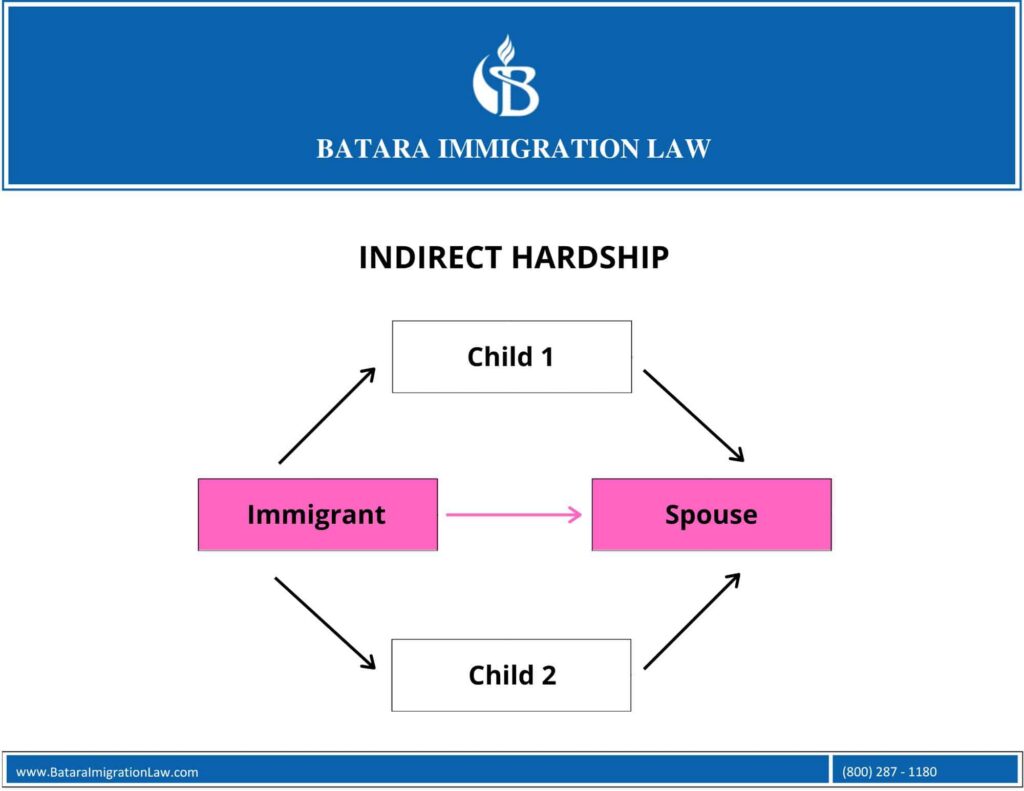
In I-601A cases, the indirect hardship connection is not optional. It is the only path that ensures adjudicators will review the hardship of children.
As explained earlier, children are not qualifying relatives under the I-601A waiver. Their hardship does not enter the legal analysis on its own. It enters through the back door, through its impact on the qualifying relative spouse. Think of it this way: you want to show that when a child suffers, the qualifying relative spouse suffers.
The ripple effect to the qualifying relative spouse underlies the relevance of children’s hardship in I-601A cases. Without that connection, the children’s hardship is legally invisible.
Every applicable hardship issue must be linked, explicitly and convincingly, to what it means for the qualifying relative spouse.
Consider:
- For a child who struggles academically: What does that mean for the qualifying relative spouse who must manage those struggles alone?
- For a child whose cultural identity is slowly diminishing: What does that mean for the qualifying relative spouse who must carry that cultural responsibility without support?
- For a child whose medical needs go unmet abroad: What does that mean for the qualifying relative spouse who must watch that happen, powerless to fully help?
In I-601 and Cancellation of Removal cases, this indirect hardship connection is not the only path for demonstrating the hardship on children. It is, however, a strong complement to the direct hardship evidence of qualifying relative parents.
Presenting both the direct hardship to the child and the indirect hardship to the qualifying relative spouse creates a two-layered argument that is significantly stronger than either layer alone.
Immigration officers and judges are not oblivous to the plight of children in hardship cases. They know that a parent who watches their child suffer, who cannot fully protect them, who cannot restore what had been lost, is adversely affected as well. This is precisely why both hardships – one belonging to the child, the other to the parent – must be documented to the fullest extent possible.
Beyond documenting the child’s hardship thoroughly, applicants for hardship relief should ask for every issue that applies, “What does this mean for the qualifying relative spouse?”
Answer that question specifically, humanely, and completely. This is how the ripple effect becomes hardship evidence.”
From Pebbles To Boulders: Building The Case One Child At A Time
A family with multiple children does not have one hardship narrative. It has several.
Each child has their own age, developmental stage, medical history, educational needs, emotional bonds, and social connections. What is devastating for one child may be less acute for another. What is irreplaceable for a teenager may be different from what is irreplaceable for a toddler.
This means a separate hardship analysis should be conducted for each child in the family. A declaration that speaks generally about “the children” misses an opportunity to present the various issues different children will face in their entirety. The more individualized the presentation, the more persuasive the case.
Do not treat siblings as if their hardships are identical or as a singular, shared experience. Instead, present their experiences as independent narratives – because each child’s loss is their own.
Writing The Hardship Narrative: The Power Of Specificity
The difference between a weak hardship narrative and a compelling one is stark.
Compare these two approaches:
A parent weakly declares: “My child is a U.S. citizen and she would suffer if I am not here.”
Another parent says: “My daughter Sofia is nine years old and was diagnosed with Type 1 diabetes at age six. She receives insulin therapy managed through a continuous glucose monitoring system and sees a pediatric endocrinologist every three months. Her treating physician has provided a letter confirming the level of specialized care Sofia requires and the risk of diabetic complications if that care is interrupted.”
Evidence has been provided showing that this level of specialized care is not available in the immigrant parent’s home country. Sofia’s mother, the qualifying relative, works full-time as a home health aide. Without the immigrant parent’s involvement, she cannot manage Sofia’s medical appointments, school accommodations, and overnight glucose monitoring alone.
The difference between these two approaches is between a hardship narrative that an adjudicator can feel and one that disappears into a file.
When told in full, Sofia’s story touches multiple hardship issues simultaneously. Her health, her educational needs, and her dependence on the immigrant parent for daily care. The unavailability of comparable medical care abroad and the indirect hardship to her mother as the qualifying relative spouse.
Each of those issues is documented, specific, and persuasive.
In I-601 and Cancellation of Removal cases, Sofia’s story is direct hardship evidence. Her suffering qualifies on its own.
On the other hand, in I-601A cases, Sofia’s story only reaches the adjudicator through her mother, the qualifying relative spouse, who works full-time caring for others while being unable to fully care for her own daughter without the immigrant parent at her side.
This is the standard every hardship narrative should aspire to.
- Not generalities. But specifics.
- Not conclusions. But supporting evidence.
- Not a simple “My daughter would suffer” commentary. But a “Sofia, age 9, diagnosed at 6, monitored overnight, whose mother cannot take care of her alone” narrative.
This is what wins hardship cases.
The Totality Of The Circumstances
In the vast majority of cases, no single issue wins by itself.
A child’s medical condition alone may not be enough. A child’s academic performance alone may not be enough. A child’s cultural and religious connections alone may not be enough. But assembled together – each presented as part of a larger picture – these issues build something far more powerful.
USCIS adjudicators and immigration judges are required to weigh all hardship factors cumulatively, for all qualifying relatives, across all issues, in their totality.
No single factor must be extreme on its own. It is the combined weight of everything presented that determines the outcome.
Successful hardship cases usually tell a story that is simultaneously legal and human.
They meet the evidentiary standard. They cite the right precedents. And they make the reader grasp something important. Whether it’s an officer reviewing a waiver file, or a judge presiding over a removal hearing, the picture is clear. Behind the parent’s application for relief stands a real child whose future rides on the outcome.”
Build the cumulative case. Document it thoroughly. Present it specifically. Let the totality speak for itself.
Children: The Heart Of Hardship
We began this article with a simple proposition: children count.
To reiterate: children are not peripheral to a hardship case. They are not simply supporting characters in a legal proceeding. They are the living, breathing proof of what is at stake. They represent the most human evidence available that the family’s suffering is real, specific, and deserving of the government’s leniency.
The immigrant parent who faces a waiver denial or removal is not just seeking a legal status. They are, quite often, a parent who braids their daughter’s hair every morning, who coaches the soccer team, who reads at bedtime, who speaks the heritage language, who anchors the family’s cultural and religious life.
When that parent is removed, or the family is uprooted, it is often the children who feel that loss most deeply – children whose entire world is here.
Document each child’s loss thoroughly. Connect every dimension of their hardship to the qualifying relative’s suffering.
When that parent is removed, or the family is uprooted, the children often feel that loss most deeply. Their entire world is here.
Tell their story.
Make it impossible for an adjudicator or judge to reduce that family to a case number.
Children count. They are often the heart of the hardship case. And they deserve to be treated that way.
If you would like guidance in evaluating or preparing your hardship case, let’s get started with a Personalized Strategy And Planning Session.