Many immigrants seeking an I-601 or I-601A waiver underestimate its complexity. They do not understand what the law requires them to prove about the hardship their qualifying relatives will face if they are separated or forced to relocate abroad.
Most know the common meaning of hardship. But they do not grasp that extreme hardship is a legal standard – not simply a description of loss and pain.
As a result, waiver applications are often filed with nothing more than general statements about how separation or relocation would affect their family. They fail to provide concrete, specific details officers need to fully evaluate their claims.
This is why many waivers fall short. The pain experienced by qualifying family members may be genuine and the disruption to their lives significant.
However, immigration officers do not read between the lines. They evaluate only what is in front of them. The evidence must speak for itself.
Without thorough documentation, tied directly to the legal standard of extreme hardship, even a strong waiver case may be denied.
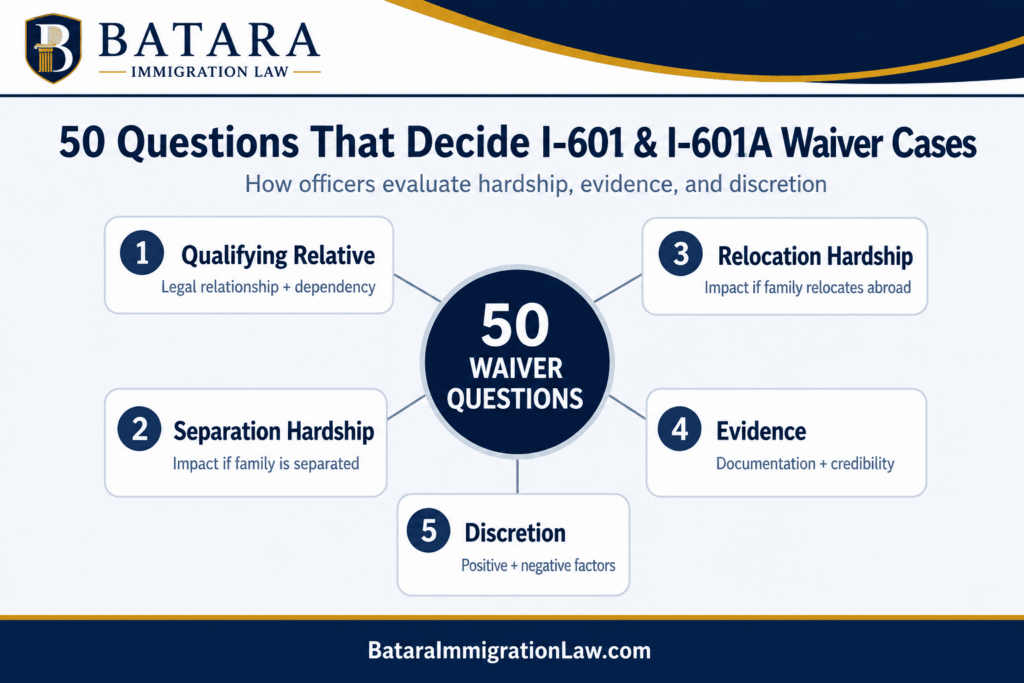
In practice, waiver decisions are shaped by a series of core questions relating to hardship. These inquiries guide how immigration officers interpret facts, evaluate evidence, and determine whether the required level has been met.
In this article, you will find 50 questions drawn from the framework officers use when assessing I-601 and I-601A applications.
The list is based on my experience helping clients in waiver cases for over 30 years. Even though such questions are not always stated explicitly, they are reflected in the decision-making of government officers.
Studying these questions closely can help you better understand the depth and specificity needed to prepare and present a strong waiver application, and place your case in a stronger position for approval.
Table Of Contents
- Establishing The Qualifying Relative Relationship
- If The Family Remains In The United States: Evaluating Separation Hardship
- If The Family Relocates: Hardship In The Applicant’s Home Country
- Supporting The Extreme Hardship Claim: What Counts As Proof
- Beyond Hardship: How Officers Exercise Discretion
- Why These Questions Matter
- Taking the Next Step In Your Waiver Case
Establishing The Qualifying Relative Relationship
Before hardship can be evaluated by immigration officers, they must determine whether the hardship claim is tied to a family member recognized as a qualifying relative under the law. This threshold issue is essential because hardship to the wrong person, no matter how genuine, may carry limited or no legal weight.
Officers also examine the nature of the relationship itself. They consider household roles, emotional support, financial reliance, caregiving responsibilities, and the practical impact the applicant has on daily life. In many denied cases, the qualifying relative relationship was legally valid, but the evidence failed to demonstrate his or her meaningful functional dependency on the immigrant. A strong waiver case clearly explains why this relationship matters in real terms.
Here are types of inquiries about qualifying relatives officers make:
1. Who is the qualifying relative?
2. Is the qualifying relative a U.S. citizen or lawful permanent resident?
3. What is the nature of the relationship between the immigrant waiver applicant and the qualifying relative?
4. How long has the relationship between them existed?
5. Is the relationship genuine and credible?
6. How dependent is the qualifying relative on the applicant?
7. Does the qualifying relative rely on the applicant for emotional support?
8. Does the qualifying relative rely on the applicant for financial support?
9. Does the qualifying relative rely on the applicant for caregiving or household support?
10. Would separation significantly disrupt the qualifying relative’s life?
In some cases, there may be more than one qualifying relative. The government is required to assess the hardships to each qualifying relative, separately and cumulatively.
In addition, it is important to note that which family members are recognized as qualifying relatives are different for I-601 and I-601A applications.
For a deeper look at the waiver decision-making process, see our discussion on how officers evaluate hardship claims.
If The Family Remains In The United States: Evaluating Separation Hardship
One of the central questions in most waiver cases is what would happen if the qualifying relative remains in the United States while the applicant is forced to live abroad. Officers examine the likely emotional, financial, medical, and practical consequences of prolonged separation.
Many applicants describe the sadness or upheaval caused by separation in general terms. Government officers, however, look for specific examples showing how separation would affect issues such as employment, childcare, health, finances, stability, or long-term family functioning. USCIS applies an extreme hardship standard, which requires more than proof of ordinary disruption any family would face in similar circumstances. Detail matters.
11. What hardships would occur if the applicant is separated from his or her family?
12. Would separation create emotional or psychological harm?
13. Would the qualifying relative experience financial instability?
14. Would caregiving responsibilities be affected?
15. Would separation disrupt close-knit family unity?
16. Would separation create medical or mental health risks?
17. Would separation affect the ability of qualifying relatives to maintain employment?
18. Would separation affect housing or living conditions?
19. Would separation create any long-term adverse consequences for the applicant’s family living in the United States?
20. Would hardship exceed the normal misfortunes of family separation?
An important, though often overlooked, issue is that separation may affect non-qualifying relatives, and that impact may in turn create heightened hardship for the qualifying relative. See our discussion of I-601 and I-601A qualifying relatives and hidden hardships.
If The Family Relocates: Hardship In The Applicant’s Home Country
Immigration officers also evaluate whether the qualifying relative could reasonably relocate abroad to preserve family unity. This is often a major issue. Yet, many applicants assume reunification abroad reduces their separation-related concerns and adverse consequences they will experience.
In practice, relocation may create serious obstacles involving health care, safety, language, employment, education, finances, or family support systems. These hardships often exist even where the applicant’s home country is relatively stable.
Strong waiver applications explain why relocation is unrealistic, dangerous, or severely disruptive, given the family’s actual circumstances.
Questions regarding relocation include:
21. Could the qualifying relative reasonably relocate abroad?
22. Would relocation create medical challenges?
23. Would relocation create safety risks?
24. Would relocation create language barriers?
25. Would relocation affect employment opportunities?
26. Would relocation cause financial instability?
27. Would relocation disrupt education?
28. Would relocation lead to cultural hardship?
29. Would relocation separate the family from community support systems?
30. Would relocation affect access to healthcare?
What is “reasonable relocation” is not defined under immigration law. As a result, waiver applicants and qualifying relatives should not minimize or overlook their concerns related to moving abroad.
Supporting The Extreme Hardship Claim: What Counts As Proof
Hardship claims are only as persuasive as the evidence supporting them. Immigration officials evaluate not just what is alleged, but whether those claims are supported by credible, consistent, and relevant information.
Medical records, financial statements, psychological evaluations, country condition reports, declarations, and third-party letters all play a role. Officers are trained to identify vague or unsubstantiated hardship narratives. A well-documented case is more convincing than one filled with generalized statements, inadequate explanations, or insufficient corroboration.
31. Is the alleged hardship supported by credible evidence?
32. Are medical conditions supported by medical and health records?
33. Are financial claims supported by thorough monetary and income documentation?
34. Are psychological claims supported by professional evaluations?
35. Are country conditions backed by sufficient academic and professional reports?
36. Are declarations by friends, family, and witnesses detailed and consistent?
37. Is hardship to the qualifying relative shown cumulatively?
38. Is the hardship to the qualifying relative ongoing or long-term?
39. Does the submitted evidence connect to the applicant’s situation?
40. Does the evidence, testimony, and documents support the hardship narrative?
For a broader discussion of evidence development, hardship storytelling, and presenting a persuasive waiver case, our article I-601 and I-601A Waivers: Proving Extreme Hardship provides a fuller overview.
Beyond Hardship: How Officers Exercise Discretion
Even where hardship is established, approval of a waiver case requires a favorable discretionary decision. Officers weigh favorable and unfavorable factors to determine whether approval is warranted under the total circumstances.
Positive equities include family ties, long residence, rehabilitation, work history, community contributions, and hardship to relatives. Negative considerations involve prior immigration violations, misrepresentation, and criminal history.
The way such matters are organized and presented can influence the outcome, sometimes nearly as much as the facts themselves.
Effective framing of positive versus negative factors requires close attention to various inquiries, such as:
41. Has the applicant accepted responsibility for past violations?
42. Has the applicant demonstrated rehabilitation?
43. Does the applicant have a history of compliance with government and immigration orders?
44. Does the applicant have positive community ties?
45. Has the applicant contributed to family stability?
46. Are there humanitarian considerations supporting the applicant’s waiver request?
47. Are there negative factors present reflecting on the applicant’s character?
48. Does the gravity of negative factors outweigh the positives?
49. Do the positive factors, despite no adverse ones, justify approval?
50. Would approval align with the purpose of immigration law?
Immigration officers approach discretion in two different ways. This issue is explored in Beware the Role of Discretion in I-601 and I-601A Hardship Waiver Decision-Making.
Why These Questions Matter
These questions reflect how waiver cases are evaluated—not in theory, but in practice.
A case is rarely decided based on a single hardship. Officers consider how multiple factors come together and shape the overall impact of separation or relocation on the qualifying relative.
No two waiver cases are the same. Each case involves different facts, different forms of hardship, and different challenges.
Moreover, what often distinguishes stronger cases is not just the presence of multiple hardship factors, but how clearly proof of your hardship is organized, prepared, and addressed.
Taking the Next Step In Your Waiver Case
Understanding how waiver cases are evaluated is one step. Preparing a case that addresses these issues clearly and persuasively is another.
Although there are more questions officers assess than the 50 discussed here, these cover areas of concerns they are likely to explore, almost without exception.
Nonetheless, if you prepare along the lines of inquiry outlined here, you will have taken a major step forward to waiver approval.
As I noted at the outset, many immigrants seeking an I-601 or I-601A waiver underestimate its complexity.
Since you have read this far, I doubt you are one of them.
Review And Update
This page has been reviewed by Carlos Batara, Harvard Law School graduate and immigration attorney, and updated to reflect current immigration law and case strategy considerations related to both I-601 and I-601A waiver cases.
He has represented clients for over 30 years in complex immigration matters, serving individuals and families from his Hemet headquarters, throughout Riverside County and San Bernardino County, and nationwide through a virtual immigration law office.
Last updated: August 2026
If you would like guidance in evaluating or preparing your waiver case, let’s get started with a Personalized Strategy And Planning Session.