We help families build strong I-601 and I-601A extreme hardship waiver cases to pave the way toward lawful permanent residence.
Led by Harvard Law School graduate and immigration attorney Carlos Batara, our office has spent years handling some of the most demanding waiver cases in immigration law. That hands-on experience in high-stakes matters shapes how we approach every family’s situation — carefully, thoroughly, and focused on building the strongest case possible to help keep your family together.

Extreme hardship is not a checklist. It’s your family’s story – and it must be proved the right way.
USCIS does not approve waivers simply because a qualifying relative will face difficulties if an immigrant relative can no longer remain a part of their lives. Officers are required to evaluate the total impact of being apart on the qualifying relative’s life.
This means your case should do more than describe suffering — it must demonstrate how your family’s stability would be disrupted and destabilized in ways that exceed the typical consequences of separation.
Families facing I-601 and I-601A waivers often feel scared and overwhelmed. They struggle to explain the hardship they will face if their waiver is not granted. They worry about showing the depth of the suffering which a negative decision will have on their family. Many think proving extreme hardship is impossible.
Our office uses The Extreme Hardship Storytelling Method™. It’s a caring, structured way to turn your family’s situation into a strong evidence-based story – a story the government can understand.
You may wonder what “extreme hardship” means. These waivers are not decided by emotion alone. They depend on how well you document and explain your hardship. In simple terms, it’s about how clearly you present the totality of your family’s circumstances.
This page explains extreme hardship. It also introduces our Storytelling Method For Proving Extreme Hardship. We show how we help families gather evidence, document their hardship, and present a complete view of their struggles.
Key Terms To Know
Before going further, it is important to understand the legal framework that governs waiver cases:
Qualifying Relative – The law requires that extreme hardship be shown to certain family members. These are known as qualifying relatives. For I-601 waivers, a U.S. citizen or lawful permanent resident spouse, parent, or child are considered qualifying relatives. Under I-601A waivers, only U.S. citizen or lawful permanent resident spouses or parents count.
Extreme Hardship – Hardship that goes beyond the normal consequences of family separation. Separation is always difficult. The question is whether the consequences of being apart in your case are substantially more severe than what typically occurs.
Totality Of The Circumstances – USCIS evaluates all hardship factors together. No single issue must be extreme on its own. The officer examines how financial, medical, emotional, educational, and other factors will affect a qualifying relative.
Why Waiver Cases Fail
Want to know the big secret to winning I-601 and I-601A waiver cases?
I learned it early in my career at a seminar for new attorneys. A judge, running the course, gave me a piece of advice that guides me to this day. It’s proven crucial in countless trials and appeals with immigration courts and agencies.
The advice, though simple, was profound.
Good lawyers, said the judge, prepare in advance. They know their evidence before their hearings start. They maximize their clients’ chances of success.
Unfortunately, this is often the exception, not the rule in I-601 hardship cases.
Sometimes for financial reasons, immigrants attempt to represent themselves. Many underestimate the complexity of immigration law. They fail to put in the time and energy needed to win.
Others hire legal representatives. Yet, these clients do not diligently partake in putting together their cases. They are oblivious to what actions are being taken to assemble their waiver requests.
Neither situation is ideal for winning.
In my experience, waiver cases fail not from a lack of hardship, but because hardship is not adequately documented, organized, and substantiated.
The Storytelling Method For
Proving Extreme Hardship
Too many hardship waiver cases start in the middle.
A snapshot is taken of a family’s current circumstances, projected forward, and presented as the basis of an I-601 or I-601A hardship claim. Because the I-601A is a paper-based application—without live testimony—what is submitted in writing becomes the final and only narrative the government will ever consider.
For that reason, every relevant hardship factor, every piece of evidence, and every meaningful detail must be fully developed. Yet most applicants and their representatives—including attorneys, paralegals, and notarios—fail to tell the qualifying relative’s story in its entirety.
The fundamental goal of the Storytelling Method is to humanize the qualifying relative by presenting their full life narrative. This approach prevents the common mistake of presenting hardship in an overly narrow or formulaic way. By establishing a narrative framework, the qualifying relative’s hardship is perceived as unique, personal, and specific to them alone.
Even when the hardship factors themselves are similar to those in other cases, the distinction is profound: no one else has lived this qualifying relative’s life, or the life this couple has built together.
In practice, the Storytelling Method follows a disciplined structure:
- We begin by understanding the qualifying relative’s full life story — not just their current problems.
- We identify the stability your family has built: employment, health care, financial responsibilities, childcare, and community ties
- We document the specific role the applicant plays within that structure.
- We explain how separation would disrupt the family stability in concrete, measurable ways.
- We show how financial, medical, emotional, and other hardships interact and compound the severity of separation.
We support every hardship claim with thorough, verifiable evidence.
By structuring your case this way, the government does not simply read through a catalog of problems. Officers see cause and effect. They see cumulative impact. They understand why, in your family’s specific circumstances, separation would rise to the level of extreme hardship.
That is the difference between a waiver packet and a fully developed waiver case built through the Storytelling Method.
A full explanation of the Storytelling Method is provided here.
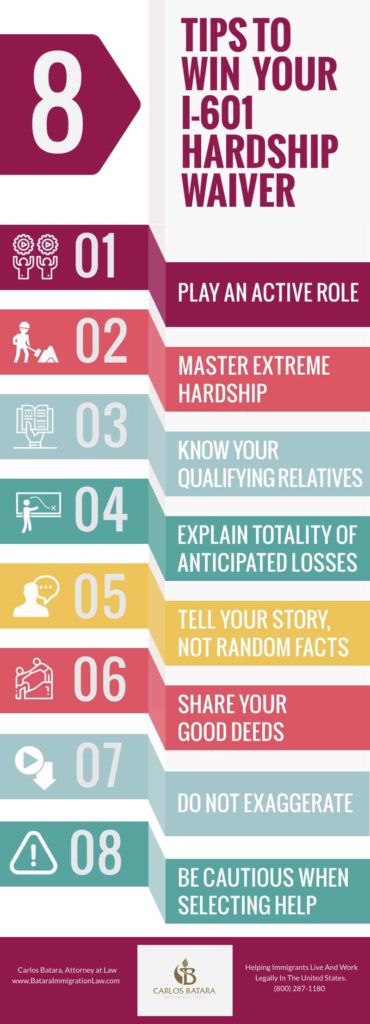
8 Tips For Building A Strong I-601 And I-601A Waiver Case
In this article, you’ll find eight insights to prepare, organize, and present evidence.
The goal?
To help waiver applicants overcome the dangers of apathy and inattention.
To improve their chances to win I-601 and I-601A waivers and defeat the threat of family separation.
With or without an attorney.
Allow me to be clear.
Preparing, organizing, and presenting WINNING evidence in any I-601 or I-601A case is not easy.
But the pointers outlined here, coupled with the Storytelling Method, will place you on the path to putting your best foot forward – before USCIS officials with discretion to grant or deny your application read your cover letter.
Table Of Contents
-
- Successful Waiver Clients Take Responsibility For Their Cases
- What Does Extreme Hardship Mean For I-601 And I-601A Waiver Cases?
- Whose Hardship Counts In I-601 And I-601A Waiver Cases? (Hint: Qualifying Relatives)
- Highlight The Totality Of Your Qualifying Relatives’ Circumstances
- Your Case Is Your Story, Not A Random Collection Of Facts And Photos
- Do Not Overlook The Significance Of Community Service
- Show. Tell. Prove. But Do Not Exaggerate
- When Seeking An Attorney, Be Cautious About Advertised Success Rates
1. Successful Waiver Clients Take Responsibility For Their Cases
Extreme hardship waiver cases require active participation from the applicant and qualifying relatives. Strong cases are built through collaboration, preparation, and sustained client involvement — not passive reliance on legal counsel alone.
The best clients – those most likely to be successful – take matters into their own hands. They take control of their cases and work closely with their attorneys.
They don’t simply drop their cases on the laps of their lawyers and disappear for months.
Lawyers cannot perform magic. They can compile evidence. They can help organize it. They can help shape it.
Yet, they cannot — or at least they should not — perform such services alone. They do not know their clients’ life history.
How can attorneys possibly know their clients’ hardships without the input and cooperation of their clients?
In reality, clients who operate in a hands-off approach are assuming some magic formula like A-B-C-D-E exists for success. But since everyone has different lives, different histories, there is no one formula to fit all cases.
What happens when clients don’t play an active role in their cases? They’re stuck clueless if they lose their cases.
Here’s an example.
Shortly after I launched my Riverside immigration law practice, an older gentleman came to visit with me. He explained that his wife was stuck in Mexico. She went to an interview. The government would not let her return to the United States.
How consular processing works was not explained to him in advance.
He was told that his wife would be able to re-enter the U.S. after her interview. No ifs, ands, or buts.
She didn’t win.
The couple had three children who were doing well in school. He worried about what would happen to them without his wife.
When I asked him about the types of evidence they submitted to the government, he could not answer. He had no idea.
When I asked if the person helping him ever mentioned anything about country conditions, like violence or medical care, he gave me a blank stare.
In fact, he had almost no understanding what his wife’s case was about.
He did not even know his wife’s time spent in the U.S. meant she had to file an inadmissibility waiver to be allowed back in.
He was clueless about his wife’s case.
He was clueless about the requirements for family unity waivers.
Some clients hear about others, like an uncle, who have the same amount of kids and work in similar jobs. They think because their uncle won, they will win. They believe their situation is the same.
No two I-601 waiver cases are ever exactly alike.
Don’t fall into the trap of thinking there is a formula. You need to present your case as if it is the most unique case ever. You need to talk about and describe your personal life.
And you need to play an active role in developing the evidence it takes to win your case.
For more in-depth information, our guide on 50 questions that decide I-601 waiver cases explains how hardship applications are often evaluated.
2. What Does Extreme Hardship Mean For I-601 And I-601A Waiver Cases?
To be perceived as extreme, your hardship must be documented in a way that shows an adverse impact substantially beyond the typical consequences of family separation and supports a favorable exercise of discretion.
Hardship is a confusing concept for many immigrant families.
The idea of an extreme hardship – not just any hardship – is challenging to grasp.
Another complication is caused by the government’s use of different standards in various areas of immigration law.
For instance, immigration courts assert exceptional and extremely unusual hardship is a stricter standard than extreme hardship.
But for immigrants, that’s not the way to look at hardship.
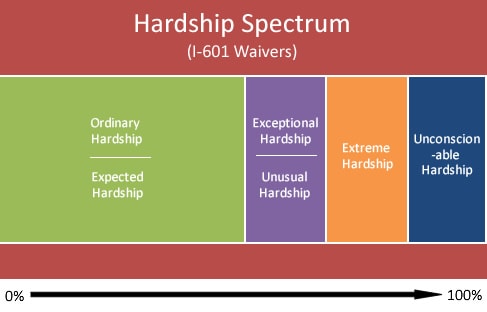
If you understand the word “extreme” means the outermost edge, you’ll be okay. The only hardship worse than extreme hardship is unconscionable hardship.
And USCIS adjudicators cannot use that standard.
The concept of extreme hardship was initially used at immigration court in suspension of deportation cases.
The same concept is now used for evaluating I-601 family unity waiver requests.
(One major difference is the qualifying relatives rule, which I will address in tip #3.)
In short, the idea is this: ordinary cases of hardship don’t win.
Whether you have to prove extreme hardship or exceptional and extremely unusual hardship, don’t get hung up on the terminology.
Just realize your hardship has to be vastly stronger than the ordinary case.
Let me explain this point a little clearer.
Ordinary hardship is losing hardship. Extreme hardship or exceptional and extremely unusual hardship is winning hardship.
Here are some quotes from actual court cases to illustrate this issue.
What is extreme hardship?
According to the Board of Immigration Appeals, “without a showing of significant or actual potential injury substantially different and more severe than that suffered by the ordinary alien who is deported, extreme hardship would not be found”.
What is exceptional and extremely unusual hardship?
In the BIA’s view, to meet this standard, “immigrants must provide evidence of harm to his spouse, parent, or child substantially beyond that which ordinarily would be expected from the alien’s deportation”.
Not much difference, really.
During the Obama Administration, USCIS issued tentative new guides for hardship cases in the I-601 waiver context.
Some pundits claimed the proposal would soften the hardship equation. Well, upon review, I did not find any ground-breaking policy additions or changes.
Slightly over a year later, USCIS issued a new policy manual.
There were no surprises.
The new guidelines did not change any existing rules. To its credit, the manual clarified a few factual situations for adjudicators.
The fundamental distinction remained in place. Ordinary is losing; extreme is winning.
So what is extreme?
Here is a simple explanation.
If you draw a hardship spectrum from 0 to 100%, we know 50% is average.
This means if your wife’s suffering is about the same as other spouses of immigrants, that is ordinary.
What if your hardship is more severe than 51% of all hardship cases? Is that an extreme hardship?
No way. It might be a tiny bit unusual. It is not extreme.
- More severe than 60% of cases? Is that extreme hardship?
- More severe than 70%? of cases? Is that extreme hardship?
- More severe than 80% of cases? Is that extreme hardship?
Okay, 90% is unconscionable. So I would guess a hardship that is more severe than 70%, or maybe 80%, of all other hardship cases is probably extreme hardship.
In spite of the definitions above, the parameters for assessing hardship from ordinary to extreme are not exact.
Reviewing officers do not assign percentages. But they compare your case – consciously or unconsciously – to hundeds of other files they have assessed. Your presentation, as a result, must differentiate your family’s circumstances from what officers typically see.
In reality, is there an ordinary alien, whose spouse will experience an average hardship?
I do not believe there is an ordinary alien. I do not believe there is an average hardship.
That is the attitude you must have about your case. And you must help those who are helping you explain your situation this way.
They cannot do it alone.
You are not ordinary. Your spouse’s hardship is not average.
Prove it.
3. Whose Hardship Counts In I-601 And I-601A Waiver Cases? (Hint: Qualifying Relatives)
Waiver law does not consider every family member’s hardship equally. Identifying the qualifying relatives is foundational for successful extreme hardship presentations.
The requirement of qualifying relatives is another issue which confuses a lot of people.
Basically, when you are presenting a family unity case, the law specifies whose hardship counts. The family members who count are your qualifying relatives.
The qualifying relatives concept baffles immigrants for two reasons.
First, as noted earlier, there are several hardship permutations. Each one defines different family members as qualifying relatives. This often puzzles immigrants over who counts and who does not count.
Second, family unity cases pertain to an immigrant’s request for a waiver. But the I-601 analysis does not focus on the immigrant’s hardship. It centers on the hardship suffered by other persons, the qualifying relatives.
For instance, take the original extreme hardship formula used in suspension of deportation cases. It allowed the evaluation of the hardship to the immigrant facing removal from the U.S.
When the law switched to cancellation of removal, it deleted the immigrant’s personal hardship from consideration.
It’s a more narrow issue for I-601A waivers.
Only a few family members count as qualifying relatives.
A U.S citizen or permanent resident spouse. A U.S. citizen or permanent resident parent.
Hey, wait a minute? What about the kids?
They are not qualified relatives.
(By the way, this is an improvement over the early Stateside I-601 family unity waivers implemented by President Obama for immigrant families. That list excluded permanent resident parents and spouses.)
In essence, I-601 and I-601A waiver applicants have to know their qualifying relatives.
They have to know whom they are building their cases around.
Their evidence must center on the hardship of their qualifying relatives.
It’s mission-critical.
4. Highlight The Totality Of Your Qualifying Relatives’ Circumstances
USCIS evaluates extreme hardship under a totality of the circumstances formula. This means all relevant hardship factors must be assessed together as a cumulative whole, and not only in isolation on a piecemeal basis.
Totality of the circumstances is the real test for evaluating hardship.
This means all circumstances of hardship should be explained by the immigrant and examined by the I-601 examiner.
There are direct and indirect factors of I-601 family unity hardship.
Let’s dive into this.
Assume we are discussing the hardship of a lawful permanent resident spouse. The hardship of the children does not count.
Really?
Yes, really, because children are not qualifying relatives for I-601 waivers.
But this you should know. We’re talking about direct hardship.
The suffering and losses of children caused by separation of a parent do not count. Because they are not qualifying relatives.
But what if a spouse’s hardship is adversely impacted and made worse because of the children’s suffering and losses?
Well, then, it does affect her hardship, doesn’t it?
Their hardship is an indirect factor of your spouse’s hardship.
Keep that in mind.
Totality of the circumstances.
Remember, too, since government officers can make discretionary decisions, two may look at the same hardship issues but view the impact differently.
Do not overlook indirect factors of hardship.
Do not overlook the suffering and losses of non-qualifying relatives. They’re part of the totality of the circumstances.
Let me give you a tactical tip.
When you present your I-601 waiver case, prepare your case for the meanest, rudest, strictest, smartest adjudicator you will ever meet.
Why?
Because if you don’t, you might not be ready on the day of reckoning.
‘Tis better to prepare for a hardened officer and get a sympathetic officer – than to prepare for a sympathetic officer and end up with a hardened one.
Over the years, helping clients facing requests for evidence, I have learned a simple yet critical fact. Waiver cases that are prepared for rigorous scrutiny fare better even with unsympathetic officers. Strong structure coupled with organized evidence can withstand skepticism.
Always prepare for the toughest possible opponent.
Always. Always. Always.
The officer who will decide your I-601 waiver case has discretionary power.
He can look at your evidence, and conclude, “You have presented a lot of good evidence. Yet, I don’t think your situation rises to the level of extreme hardship.”
Remember this tip, and you’ll never take preparation too lightly.
For families preparing a waiver case, knowledge that hardship must be proven is rarely enough. As our page on how officers evaluate hardship claims explains, it is also crucial to grasp the legal framework underlying I-601 and I-601A decisions.
5. Your Waiver Case Is Your Story, Not A Random Collection Of Facts And Photos

A persuasive waiver submission presents a coherent hardship narrative supported by concrete evidence and focused discusson, rather than a disorganized collection of documents and mere emotional statements.
If you have browsed this website, you may have watched my video where I talk about meeting Charles Kuralt.
At the time, Kuralt was a famous journalist. Every Sunday evening, he would interview someone off the streets and tell their life story in an hour. His show was nationally televised.
Kuralt’s tales were heart-warming, inspirational, and authentic. Year after year, he won a Pulitzer Prize for his reporting.
When I started college, I wanted to be a journalist. I wrote for the school paper. When Kuralt came on campus to speak, I was given the assignment to interview him.
I asked him, “Mr. Kuralt, how do you choose your subjects? How do you find these people? Who does the research?”
I suspected he had a large research team.
He answered, “Carlos, the process is relatively simple.”
The way he described it, it was like Pin The Tail On The Donkey.
He explained. “I go to a room in our company studio. My team blindfolds me. In the room is a big map of the United States. My team spins me around. They walk me to the map, and I stick a needle on the map. Whatever city or rural area I hit, we travel to.”
“When we get there,” he added, “we ask people if they would allow me to interview them. The first person who says yes is who I interview. A few weeks later, that individual’s story is presented on television.”
I thought to myself, “What an amazing formula.”
He told me, “Let me give you a secret. Everybody – absolutely everybody – has a Pulitzer Prize novel in them. They just need the right storyteller.”
He shaped the way I look at immigration cases today.
He shaped the way I handle waiver applications today.
Every immigrant and every immigrant family has a special story.
It does not matter what country you’re from. You have traveled so many miles. You have experienced many ordeals and obstacles in your life.
And now you’re married to a U.S. citizen or permanent resident.
You may have children. You probably have hopes of buying a home. You want to travel. You want to be able to put food on the table for your family.
In other words, you want to live the American Dream.
This is why you and your spouse seek to win an I-601 family unity waiver.
You – and your spouse – have a special story.
You need to make sure you tell that story when you present your waiver request.
It’s your case. It’s her hardship. It’s your family’s story.
Recommended Reading: Learn when and why you need an immigration lawyer to write a hardship letter for your wife or husband. Click here: When Do You Need An Immigration Lawyer To Write Your Hardship Letter?
If you have someone helping you, you have to make sure he or she understands that they have to tell your family story.
All the details of your family story – the employment, the home, the school – must be put together in a way to share your Pulitzer Prize novel.
The I-601 application should not be a mere recital of facts and compilation of photos. Rather, it should serve as the Pulitzer Price rendition of your family story.
Some commentators suggest officers prefer shorter packages of evidence. Because they have too many cases, they want to narrow their review to fewer issues.
I disagree.
If you have outlined other issues, the minor issues, do not exclude them. They count.
As long as you structure your evidence in an easy-to-follow format, there is no reason to exclude them.
When you combine them with your main issues, you’ll be one step closer to winning your case.
Under the totality of circumstances test, I-601 waiver decisions rest on cumulative hardship.
Do not ignore less significant factors.
To the extent they heighten suffering, they are part of your family’s hardship story.
Do tell your story. In full.
6. Do Not Overlook The Significance Of Community Service
Because waiver decisions are discretionary, evidence of community involvement and positive social contributions can influence how officers weigh a case.
Another issue you should raise, whenever possible, is community service.
It’s an issue I have often argued about since the beginning of my career.
Even today I disagree with how officers view the social contributions of my clients.
Legal precedent then and now borders on “elitist thinking.”
I was once cut off in closing argument about this issue by an immigration judge. As I discussed the merits of my client’s community service, he became unglued when I critiqued the tendencies of existing precedent.
He interjected, “Are you implying that I grew up with a silver spoon in my mouth?”
How he drew that conclusion is beyond me. I knew nothing about his childhood years.
But oh well . . . If the shoe fits . . .
My point is this. Community service is not limited to being the president of the Kiwanis Club or an officer of the Chamber of Commerce.
You could be a volunteer for your church, for your child’s school, for the YMCA. You could teach toddlers to swim. Illiterate adults to read. Teenage girls to play soccer.
You are there every week, every Saturday, and you give your best.
That, too, is community service.
Yet, as an immigration appeals attorney, when I read the transcripts and review the evidence submitted in denied I-601 waiver cases, I’m awestruck with the absence of community service evidence.
Why aren’t more lawyers using community service in their hardship cases?
And why do those who incorporate such matters usually limit their presentations to elite-thought positions.
You might be thinking community service is irrelevant to a hardship analysis.
You would be wrong.
Consider two immigrant fathers. Each has two U.S. citizen sons, ages 9 and 12.
One sits around in the backyard every Sunday, consuming beer after beer with friends. He takes little to no interest in his kids’ education. He doesn’t motive them to play sports or engage in school activities.
The other reads to the children in the evenings, encouraging them to become astronauts, doctors, or accountants.
He is an assistant coach on their youth sports teams. He attends the school PTA meetings and volunteers at school events.
Any difference?
Any difference in how the two sets of children will miss their father if he loses his family unity case?
There is a difference, you assert, but it’s irrelevant. The sons are not qualifying relatives.
Think again.
What about the mother of these two boys?
If her husband cannot return to the U.S., will she suffer the effects of the father-son separations?
Need I say more?
7. Show. Tell. Prove. But Do Not Exaggerate
Credibility is critical in waiver cases, and hardship claims must be presented with precision and honesty, not hyperbolic assertions.
Compare these words:
- Discomfort versus disaster
- Misfortune versus misery
- Displeasure versus desperation
- Hard times versus hopelessness
- Difficult versus destruction
Do you sense a difference in the words?
The first set of words describe ordinary hardship. The second set describe extreme hardship, the type of hardship necessary to win I-601 waivers.
When you are presenting evidence, present it in a manner that shows your hardship is like the latter category of words, not the former.
Hardship is not just heartache, sorrow, and sadness.
(Boy, do I hear this a lot. And I say, “Stop it.”)
You need more. I understand the pain and emotional aspects of family separation.
But most heartache, well, is ordinary.
This is akin to economic and financial loss. Clients often say, “If I cannot return, my wife will not be able to buy food and clothes for the kids.”
Once in awhile economic suffering can be an extreme hardship. But not usually.
Hardship cases specify economic hardship, by itself is not enough to win a I-601 waiver.
Here’s the key.
Don’t exaggerate
In particular, don’t exaggerate when discussing your economic circumstances.
- Q: “When you go home, can you get a job?”
- A: “No, I can’t get a job.”
- Q: “Why?”
- A: “I’m too old.”
- Q: “How old are you?”
- A: “I’m 37.”
- Q: “Do you have any skills?”
- A: “No.”
- Q: “Well, did you ever have work before?”
- A: “Yeah?”
- Q: “What did you do?”
- A: “As a cashier.”
- Q: “Well, you have skills.”
Rest assured the officer is going to seek information about those skills.
Are you telling the officer there are no stores or cash registers in your home country?
Do you think the officer will blindly accept your assertion?
Don’t exaggerate.
Despite my warnings, some immigration clients try to exaggerate their hardship.
You can exaggerate to me.
You can exaggerate to your husband, wife, children, cousins, aunts, friends, community members, churchgoers, and coworkers.
It will not work on your waiver application. It is not going to work with an adjudicator.
Officers are trained to test credibility. When financial, employment, or other claims appear overstated, your application can lose persuasive force. Authenticity builds trust.
Don’t exaggerate.
Show. Tell. Prove.
Put the time into your case to present your hardship as completely as possible.
Attempts to exaggerate will undermine your I-601 waiver claim.
So I’ll say it again.
Show. Tell. Prove.
Prove your hardship.
Without exaggeration.
8. When Seeking An Attorney, Be Cautious About Advertised Success Rates
Extreme hardship waivers are complex and decisions are discretionary, so choosing legal representation should be based on experience, transparency, and advice – not marketing claims about success rates
Having made it this far, you’re to be commended.
You’re serious about presenting your best possible case to USCIS.
You might also be feeling a little overwhelmed.
So you could be thinking about seeking professional assistance.
If you are, be careful to choose someone who can competently guide you through the treacherous path of I-601 waiver law.
(Because this area of law is incredibly difficult, I think immigrant families should say no to all notarios, immigration consultants, and paralegals. Thus, my comments are focused on selecting an attorney.)
Remember the older gentleman I talked about at the outset of this article?
He chose the wrong representative.
He picked this person based on alleged success rates.
Frankly, I’m not sure what folks mean when they ask about success rates.
I understand what success means. I comprehend what success rate means. But discussions of success rates can be misleading.
Worse, they can create a false sense of security.
As they did with this gentleman.
When I first moved to Riverside, a local lawyer was running a huge telephone book ad. It proclaimed a 99% success rate.
I thought to myself, this guy must be really, really good. Or he uses a unique format to pick his cases.
What type of cases was he handling?
Visa petitions? Removal trials? Citizenship applications? Deportation appeals?
The advertisement was unclear.
Some clients who came to my office would ask me, “Hey, this guy across town promises 99% success. What do you promise?”
My response was simple.
I don’t promise a specific success rate. I don’t give percentages on my cases.
To be perfectly honest, it is impossible to provide a I-601 success likelihood rate.
Besides, what does 99% mean? Even if the 99% comment is truthful, how do you know your case does not fit into the 1%?
Are administratively closed cases the same as victorious cases?
In some closed cases, immigrant defendants may have to return back to court in three years. After the courts have caught up with its backlog of older cases.
Is this success?
In other words, watch out for promises of a guaranteed outcome.
Reviewed by Carlos Batara, Immigration Attorney
Serving clients through our Hemet headquarters, throughout Riverside County and San Bernardino County, and nationwide through virtual representation.
Last updated: August 2026
Timing Matters In I-601 And I-601A Waiver Cases: Why You May Need To Act Now
The strength of a waiver case depends on how thoroughly your family’s hardship is explained and how well it is supported by evidence. Starting preparation too late — or moving forward without a clear strategy — can leave gaps that are difficult to close once the process is underway.
Many families underestimate the level of detail these cases require. Hardship must be documented carefully, or aspects of your situation that seem obvious to you may not be understood by the officer reviewing your I-601 or I-601A application. When preparation is rushed, important details can be missed or poorly organized, weakening a case that might otherwise be compelling.
Taking the time to carefully develop your case allows you to focus on what matters most, pull together meaningful proof, and craft a coherent, complete account of what is at stake for your family.
Taking The Next Step In Your Waiver Case
If your case requires an I-601 or I-601A waiver, the foundation of your case rests on demonstrating how your qualifying relatives will be affected by your separation.
A thorough review of your family’s circumstances is necessary to show the full scope of that impact. Presenting those circumstances in an organized, well-documented way transforms a compelling story into a persuasive case.
Speaking with an experienced immigration attorney can help you understand your options and move forward with a clear path toward keeping your family together.
Frequently Asked Questions About I-601 And I-601A Waivers
Do I have to attend an interview for an I-601 or I-601A waiver?
I-601 and I-601A waiver applications are paper submissions. Decisions are made based on documents filed, not a separate in-person interview. This means the evidence filed must be thorough and well organized.
Do waiver cases require legal representation?
Waiver cases do not require anyone to hire an attorney. However, I-601 and I-601A cases involve complicated legal rules, comprehensive supporting documentation, and extreme hardship is a difficult standard to meet. As a result, many families seek legal guidance to help build their strongest possible application and prevent avoidable pitfalls.
What does “extreme hardship” mean in a waiver case?
Extreme hardship does not have a precise explanation. It is not defined in the Immigration and Nationality Act or in the Department of Homeland Security regulations. In general, a waiver applicant must show that denial of the waiver would cause a qualifying U.S. citizen or lawful permanent resident relative to suffer hardship substantially beyond the ordinary difficulties that most families experience when separated.
How does USCIS evaluate “extreme hardship” in waiver cases?
USCIS generally evaluates extreme hardship by looking at the totality of the applicant family’s circumstances, not a single factor in isolation. Medical, financial, emotional, and family-related hardships may all be relevant, and strong waiver submissions often require careful documentation showing the full range of such issues.
Is a hardship letter enough to win an extreme hardship waiver?
Usually not. While hardship letters can be helpful, most I-601 and I-601A waiver cases require far more than a single statement. Because USCIS evaluates waiver applications based on the totality of circumstances – a comprehensive hardship packet with detailed evidence is typically needed to fully demonstrate your family’s situation.
Who counts as a qualifying relative in an I-601 or I-601A waiver case?
Waiver hardship is based on the impact to a qualifying U.S. citizen or lawful permanent resident relative. Not every family relationship qualifies under the waiver statute, so identifying whose hardship legally counts is often one of the most important parts of waiver strategy.
Can hardships to children or other non-qualifying relatives still matter in a waiver case?
Yes, sometimes. Although waiver law requires showing extreme hardship to a qualifying U.S. citizen or lawful permanent resident spouse or parent, hardships to children or other family members may still be relevant.USCIS can consider how suffering experienced by non-qualifying relatives indirectly affects the qualifying relative’s total hardship.
If I qualify for an I-601 or I-601A waiver, is approval guaranteed?
No. Approval depends on both eligibility and discretionary judgment. This means even if an applicant demonstrates extreme hardship to a qualifying relative, the waiver request can still be denied. This occurs when the government weighs the positive equities – such as family ties, rehabilitation, and long-term residence — against any adverse factors, and rules against the applicant.
What happens if my I-601A provisional waiver is denied?
A denial of your I-601A provisional waiver does not invalidate your underlying immigrant petition. However, the denial carries serious consequences. If you depart the United States to attend an interview abroad, you may trigger a three- or ten-year bar to lawful reentry based on unlawful presence. For that reason, applicants should not proceed to a consular interview abroad without carefully evaluating their situation after a denial. After a denial, applicants and their qualifying relatives should consult an immigration attorney to determine what options remain.
What should I do after a denial?
While a denial represents a significant setback, it does not necessarily end the case. Before making any decisions — especially before leaving the United States — carefully review the denial notice and determine:
- The specific reasons USCIS gave for the denial
- What evidence was originally submitted and what USCIS found insufficient
- Whether additional documentation is now available
- Whether new or changed family circumstances may strengthen the case
The next step depends entirely on the reasons for the waiver denial and the overall facts of the case.
Can I appeal a denied I-601A waiver?
No formal appeal process exists for I-601A provisional waiver denials. In some cases, it may be possible to file a motion to reopen or reconsider based on a legal or factual error. In other situations, it might be in the best interests of applicants to file a new I-601A waiver application supported by stronger hardship documentation.
Can I reapply if my waiver application was denied?
Yes. Reapplication is one of your possible options after a denial. You will need to pay the filing fees again. Before resubmitting, carefully analyze the reasons cited in the denial. A subsequent application should present clearer, stronger, better-organized documentation of extreme hardship to the qualifying relative. It should include new evidence or changed family circumstances that strengthen the prior submission. Do not simply repeat what you said earlier.
Reviewed by Carlos Batara, Immigration Waivers Attorney
Serving clients through our Hemet headquarters, throughout Riverside County and San Bernardino County, and nationwide through virtual representation.
Last updated: February 2026
Additional Immigration Services
For an overview of all immigration matters we handle, in addition to our I-601 and I-601A waiver services, visit our Immigration Legal Services page.
I-601 And I-601A Waiver Representation In California And Nationwide
Facing separation from your family? A waiver could keep you together.
Waiver cases are among the most challenging areas of immigration law. Proving extreme hardship requires comprehensive evidence, strong family relationships, and strategic presentation. A properly prepared waiver application can mean the difference between family unity and family separation or relocation.
Batara Immigration Law helps waiver applicants demonstrate extreme hardship, serving clients through our regional offices and service hubs, including:
Nationwide Representation: I-601 and I-601A waivers are mostly done through written submissions. Because of this, representation does not depend on an attorney’s physical location. Our virtual immigration law office enables us to prepare and file I-601 and I-601A waiver applications for clients anywhere in the U.S. This means we can help individuals and families no matter where they live.
Ready to take a serious and honest look at the strengths and weaknesses of your immigration case? Schedule your personalized strategy and planning session today.