When a Request For Evidence or Notice Of Intent To Deny arrives from the government, it often creates immediate fear.
For many families, the concern is simple:
“Is this the beginning of the end?”
In most situations, it is not. But it can become one – if the response is incomplete, rushed, or poorly organized.
What you do next will determine whether your case moves forward – or comes to an abrupt end.

Question:
“I’m trying to immigrate my wife. Today, the government sent a letter asking for more evidence to prove our marriage is real. We do not have any more evidence. Does this mean our case is over?“
(Submitted by Jesus O., San Marcos, CA)
Answer:
Absolutely not. A request for more evidence is not a denial notice. As long as you can keep fighting to keep your family together, you should keep fighting.
Below, I address the most common questions about Requests For Evidence — and explain how they differ from a more serious notice the government sometimes sends when it is already leaning toward denial.
Carlos Batara is a Harvard Law School graduate and immigration attorney with over 30 years of experience helping clients respond to Requests for Evidence (RFEs), Notices of Intent to Deny (NOIDs), and other complex immigration challenges.
Does An RFE Or NOID Mean Your Case Will Be Denied?
A Request For Evidence does not mean your immigration case will be denied. It means the government needs more information before making a decision.
A Notice Of Intent To Deny, however, is more serious. It means the government believes your case should be denied unless you provide strong evidence to overcome specific concerns.
Both notices require careful attention. The difference lies in how close your case is to denial – and how urgently you must respond.
In essence, a NOID is an urgent RFE.
RFE vs NOID: Understanding The Severity Of Your Situation
Not all immigration notices carry the same weight. It helps to view them along a spectrum:
Request For Evidence (RFE)
The government needs additional documents or clarification before deciding your case.
Notice Of Intent To Deny (NOID)
The government has identified serious problems and intends to deny your case unless those issues are overcome.
Denial
The case has been rejected. Options become more limited and time-sensitive. But in many instances, pathways to permanent residence remain available, including filing motions to reopen or reconsider with USCIS.
An RFE is a request for more information.
A NOID is a warning that your case is at risk.
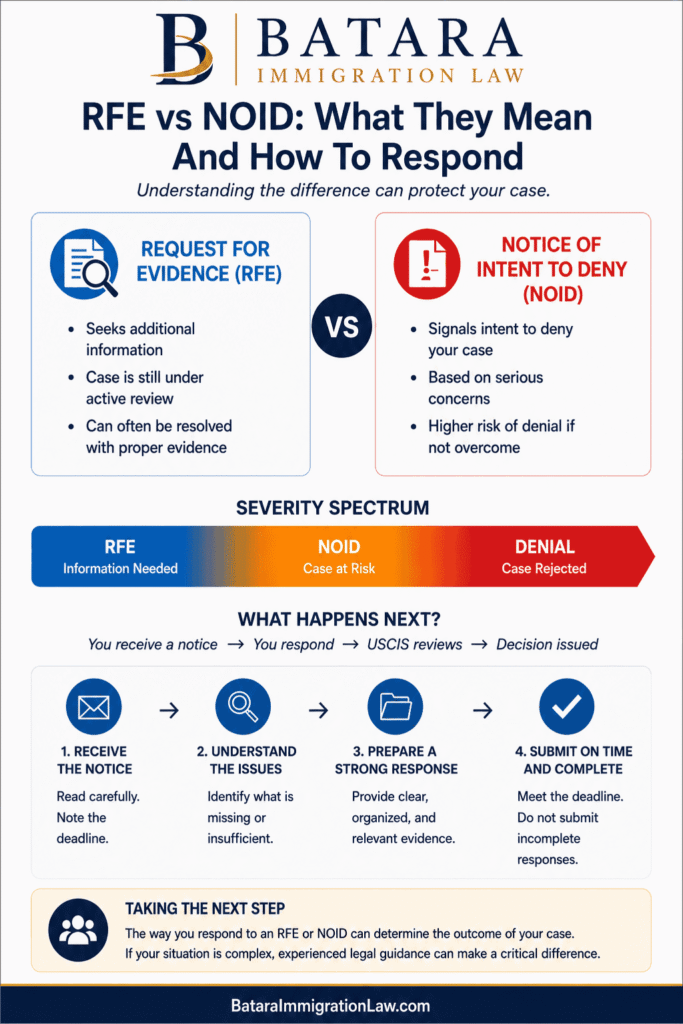
Table Of Contents
- What Is A Request For Evidence (RFE)?
- What Is A Notice Of Intent To Deny (NOID)?
- Common Reasons Why USCIS Issues RFEs And When Cases Move Toward NOIDs
- What USCIS Looks For – Including Evidence Applicants Often Overlook/a>
- What Happens If The Issues Are Not Resolved
- When The Stakes Are Higher Than They Appear
- Taking The Next Step In Your Case
- Frequently Asked Questions About RFEs And NOIDs
What Is A Request For Evidence (RFE)?
Generally, a Request For Evidence is issued due to a problem or omission in the paperwork you filed with USCIS.
In most cases, the government will give you 87 days to respond (measured from the date they mailed the RFE to you.)
The time allowed for your response could be shorter, so be sure to check your deadline. If you fail to reply by the due date, your immigration application could be denied.
What Is A Notice Of Intent To Deny (NOID)?
If you receive a NOID, this means that after reviewing your application, a USCIS officer does not think your spouse qualifies for the immigration benefit she seeks.
Although a Notice Of Intent To Deny is not an official denial, it is an announcement that you will receive an official denial if you and your spouse cannot provide convincing evidence to show her green card application should be approved.
To be clear, NOIDs are a step closer to green card disaster than RFEs.
Common Reasons Why USCIS Issues RFEs And When Cases Move Toward NOIDs
When does the government request additional evidence from immigrants and their spouses?
There are three common situations which often occur, causing immigration authorities to seek more information from green card applicants
- You may have failed to send important documents to support your application packet
- The evidence you submitted might be insufficient to show you qualify for a green card
- There is a possible legal issue which needs to more closely reviewed by the USCIS officers
An RFE does not mean your case is weak. It means the government needs more evidence to complete its review.
In marriage-based cases, this often means the government wants more evidence that your relationship is real.
Actually, the government does immigrants a favor when it requests more evidence. If you read the RFE closely, it usually lays out what you need to prove.
What USCIS Looks For – Including Evidence Applicants Often Overlook
This is where many cases are won – or lost.
When clients tell me they do not have any more evidence, they are almost always wrong.
They simply have not yet figured out where to look.
Look Beyond Traditional Paperwork
You may not have more paper evidence, like rental receipts, tax papers, or bank accounts.
But I bet you have a lot of friends, relatives, and neighbors who know about your marriage.
These individuals can testify on your behalf, usually in writing. Be careful. Their statements must be prepared according to strict rules.
Think About Your Shared Experiences
If you go to family birthday parties, wedding receptions, holiday gatherings, you usually are familiar with a lot of people there. Pick a few. Most likely, the ones you and your wife talk to the most can vouch for your marriage. They might even have photos they took at some of the events.
Photos can help your case.
Do you ever go to sporting events or the movies with other couples? You might request these friends or relatives to help you and your wife out.
Are you involved with church? Or community organizations?
What are you and your wife’s hobbies? Do you play in any sports leagues? Does you wife take classes like cake decorating or scrap booking?
These everyday interactions often provide valuable evidence.
Consider Your Daily Life Together
Now, let’s take a step back. Are you really sure you have not overlooked possible paperwork evidence in your possession?
Often, when I question clients, they realize there is more documentary evidence they can locate and provide to the government.
For instance:
- Employment Records: Do you or your spouse have an medical health plan at work? Soon after your marriage, you may have changed the number of dependents for your work checks. This is written evidence.
- Insurance: What about your cars? Do you have joint car insurance? Do you have a life insurance policy that lists the other spouse as a beneficiary?
- Children: Do you have children? If so, there is normally a lot of paper evidence pertaining to your kids. School records. Dentist records. Immunization records. These records can support your case.
- Electronic And Household Records: Have you purchased a new television, a new computer, or a new Iphone? Do you have an Amazon account? How about your cell phone invoices and internet bills?
- Letters And Cards: Do you get letters, birthday cards, or holiday greetings from your parents or relatives?
- Financial records: How about joint bank accounts, tax filings, shared bills, or receipts from purchases made together?
- Social Media: Maybe the two of you post on Facebook or Tik Tok? Such posts, as well as tagged photos, and shared location check-ins can also support your case.
Sometimes you just need to speak with a person outside your daily sphere to get ideas. He or she can sometimes figure out types of evidence you overlooked.
In hardship waiver cases, the key issue is often not whether documents exist, but whether they answer the questions immigration officers are actually asking. Our guide, 50 Questions That Decide I-601 & I-601A Waiver Cases, explains the issues officers evaluate when determining whether extreme hardship has been established.
So if you’re trapped in this situation, and you feel stuck, don’t give up hope so easily.
I want to re-emphasize this point.
An RFE notice is not a warning that a denial is forthcoming.
If you’re unsure or scared about what to do, I suggest getting advice from a lawyer who specializes in immigrant family and relative visa petitions.
Organize And Present Your Response Clearly
Do not just send documents in a haphazard manner. Your response should be:
- Organized
- Easy to review
- Focused on the specific issues raised in the RFE
A clear, well-organized presentation helps the reviewing officer understand your case quickly and accurately.
Do not underestimate the effort required. The steps outlined above typically require several hours of planning, researching, assembling, and presenting your evidence.
It is worth doing everything possible to make it as simple and obvious for the government to grasp. It’s a formula for success I have learned over the years helping green card applicants as a permanent residence attorney.
What Happens If The Issues Are Not Resolved
If you fail to respond to an RFE or NOID, your case will almost always be denied.
Deadlines are strict. Even a late or incomplete response can lead to the same result.
If yours is a real marriage, don’t spend too much time worrying.
Doing is preferable.
When The Stakes Are Higher Than They Appear
SSometimes the issue is not simply missing paperwork.
There may be questions about:
- The authenticity of the relationship
- Concerns about immigration history
- Inconsistencies in prior immigration filings
- Legal eligibility issues
These situations require more than gathering documents. They require careful case analysis and strategic development of your response.
If any of these problems are present in your case, seeking experienced legal counsel is strongly advisable.
Taking The Next Step In Your Case
Based on the details in a situation like yours, an RFE typically means the government wants more evidence — not that a denial is coming. That is an important distinction.
If you are handling your case on your own, take the time to understand what the government is really asking for, and respond in a clear and organized way.
Pay close attention to the issues raised. Do not submit documents without explaining how they address the government’s concerns.
If you feel uncertain or overwhelmed, it may be time to speak with someone who handles these cases regularly.
I’ll say it again, do everything possible — because it is your family’s future in the United States that is at stake.
Review And Update
This page has been reviewed by Carlos Batara, Harvard Law School graduate and immigration attorney. He has represented immigrants and families for over 30 years in responding to RFEs and NOIDS, green card applications, appeals, and complex immigration matters.
Last updated: May 2026
Frequently Asked Questions About RFEs And NOIDs
Does an RFE mean my case will be denied?
No. A Request For Evidence means USCIS needs more information before it can make a decision. Many RFEs are resolved with a well-prepared response. Failing to respond, responding late, or filing a poorly-prepared response can ultimately result in denial.
Is a NOID worse than an RFE?
Yes. An RFE usually involves a request for missing or incomplete information. A NOID indicates the government has already identified specific reasons it believes your case should be denied. Sometimes a NOID follows after an applicant fails to respond or fails to adequately respond to an RFE.
How long do I have to respond to an RFE or NOID?
For most RFEs, USCIS typically allows 87 days from the mailing date. However, some notices carry shorter deadlines. Always follow the exact deadline printed on your notice, Missing the due date can lead to denial. The deadline to respond to a NOID is much shorter, usually just 33 days from the date of mailing.
Can I submit new evidence in my response to the RFE?
Yes. You should submit all relevant evidence that supports your case and addresses the concerns raised in the RFE. Do not limit yourself to what you originally filed. If USCIS overlooked or misunderstood the significance of documents already filed, you should point out the USCIS error in writing.
What happens after I respond?
The government will review your response and issue a decision. Responses that are well-organized, complete, and directly address the RFE or NOID concerns have the strongest chance of success.
What if the issue is not just about documents?
If your RFE or NOID raises questions about your relationship, your immigration history, or a legal eligibility issue, gathering documents alone may not be enough. These situations means USCIS is evaluating credibility or consistency. which may require you to seek legal legal guidance to identify the real concerns and build a sufficient response.
How should I approach responding to USCIS?
Both types of USCIS notices require a careful, complete response that addresses the concerns raised by USCIS. For a step-by-step guide focused on RFE responses, see our guide on How To Respond To A Request for Evidence.
RFE And NOID Assistance Throughout Hemet, San Bernardino County, And Riverside County
A Request For Evidence or Notice Of Intent To Deny does not automatically mean your case is headed toward denial.
But it does mean your case has reached a critical stage.
In many situations, what you do next can directly affect the outcome. A carefully prepared response to an RFE or NOID can strengthen your case and move it toward approval.
Depending on the circumstances, the right approach may include:
- Preparing a complete and well-organized RFE response
- Addressing the specific concerns raised in a NOID
- Supplementing your case with stronger supporting evidence
- Clarifying inconsistencies or legal issues identified by USCIS
The key is not just submitting documents—but presenting a response that directly answers the government’s concerns.
Careful legal guidance can help you identify the issues in your case, avoid common mistakes, and put forward the strongest possible response.
If you need assistance with an RFE or NOID, learn more about our regional offices and service hubs:
No matter where you live, we are committed to protecting your rights, exploring every available option, and helping families remain together whenever the law allows.
Nationwide Representation: Many clients also choose to work with our office remotely through our Virtual Immigration Law Office, enabling individuals and families across California and the United States to receive experienced immigration representation without needing to travel for in-person meetings.
Looking for assistance with responding to a Request For Evidence or Notice Of Intent To Deny? Schedule a personalized strategy and planning session today.