When a remarriage leads to a second green card petition, USCIS review extends beyond the current relationship. Government officers examine the past and present marriages to determine whether each union was genuine or entered into solely to obtain immigration benefits.
In short, the current marriage does not insulate spouses from questions about the prior one. Heightened scrutiny can arise from either direction.

If the first petition was denied, or raised concerns about the authenticity of that marriage, those doubts follow the immigrant into the new case. Conversely, red flags in the current marriage can cause USCIS to look back and reevaluate the earlier relationship more critically. Either marriage can become the lens through which the other is judged.
In some cases, the government’s assessment can lead to application of the Marriage Fraud Bar, a finding that permanently blocks approval of family-based petitions, even when the current marriage is entirely legitimate.
Successfully navigating these issues requires understanding how the history of past marriages may affect the outcome of second marriage-based petitions filed involving either spouse.
Carlos Batara is a Harvard Law School graduate and immigration attorney with over 30 years of experience helping clients navigate complex immigration cases, appeals, and post-denial strategies.
All that is gold does not glitter. Not even wedding rings, especially from second spouses.
Because marriages are one of the easier paths to winning permanent residence, they invite close immigration scrutiny.
An immigrant’s second marriage prompts extra caution. Besides assessing the authenticity of the current union, government officers probe the first marriage and divorce for indicators of marriage fraud.
In other words, immigrants seeking a green card through a remarriage need to be prepared to prove that not only their current, but also their former marriage was built on a bona fide relationship.
Table Of Contents
- Immigrant Divorces: The Roots Of Marriage Fraud Allegations In Second Marriages
- Immigrant Remarriage: A Perilous Connection To Marriage Fraud Suspicions
- Three Ways Remarriages Lead To Second Permanent Residence Applications
- Why Do Immigrant Petitions For A Second Spouse Lead To Heightened Scrutiny?
- When Can A Permanent Resident Sponsor A New Spouse For Green Card Benefits?
- How To Deal With Allegations Of Past Immigration Marriage Fraud
- Frequently Asked Questions About Remarriage And Green Cards
- Second Marriages, Second Chances
Immigrant Divorces: The Roots Of Marriage Fraud Allegations In Second Marriages
For many immigrants, the problems they encounter in their efforts to legalize their status through a second marriage stem from earlier family court divorce proceedings.
As with their defense of foreign-born spouses trapped in hostile divorces, too few family law attorneys grasp how certain actions they take in dissolution cases, which might be safe for U.S. citizens, will undermine the ability of immigrants to remain in the United States.
Years later, the issues are often exacerbated when the immigrant divorcees, alone or with their legal representatives, fail to thoroughly review their family law court records before filing new immigration benefits.
They appear at their USCIS appointment assuming this time a grant of permanent resident status is just around the corner.
Instead, they are subjected to extensive questioning regarding their past and present marriage-based applications.
Their responses, blind to the government’s concerns, open the door to Requests For Evidence (RFEs) or Notices Of Intent To Deny (NOIDs), based in some cases on allegations that their prior marriage was fraudulent.
Immigrant Remarriage: A Perilous Connection To Marriage Fraud Suspicions
Approximately two million marriages per year take place in the United States.
Family law statistics show that 41% of first marriages end in divorce. The number rises to about 60% for second marriages.
For marriages involving an immigrant spouse, the figures are slightly lower, varying from ethnic group to ethnic group.
It is unknown how many marriages involving immigrant spouses are related to immigration fraud.
The government often cites the last known survey on this issue, now several years old, that claimed up to 30% of marriages between U.S. citizens and immigrants may be fraudulent.
The report, experts have shown, is based on several flawed assumptions.
Yet, even if only 1 of 5 immigrant divorces ensnare a foreign born spouse in cases where red flags surface, that means several thousand remarried immigrants may be forced to surmount suspicions of fraud before permanent residence is granted.
Such suspicion does not require a prior fraud finding to create problems. The government concerns can arise from an unresolved earlier petition. an incomplete evidentiary record, or circumstances in the current marriage which causes USCIS to look backward.
As a result, immigrants seeking a green card through a second or third marriage need to tread forward cautiously.
Over the past decade, an increasing number of couples have sought my assistance to help them contest such allegations.
To help you understand what types of issues the government wants to know about first marriages, this article will discuss three different remarriage scenarios that often spark government suspicions.

Three Ways Remarriages Lead To Second Marriage-Based Permanent Residence Applications
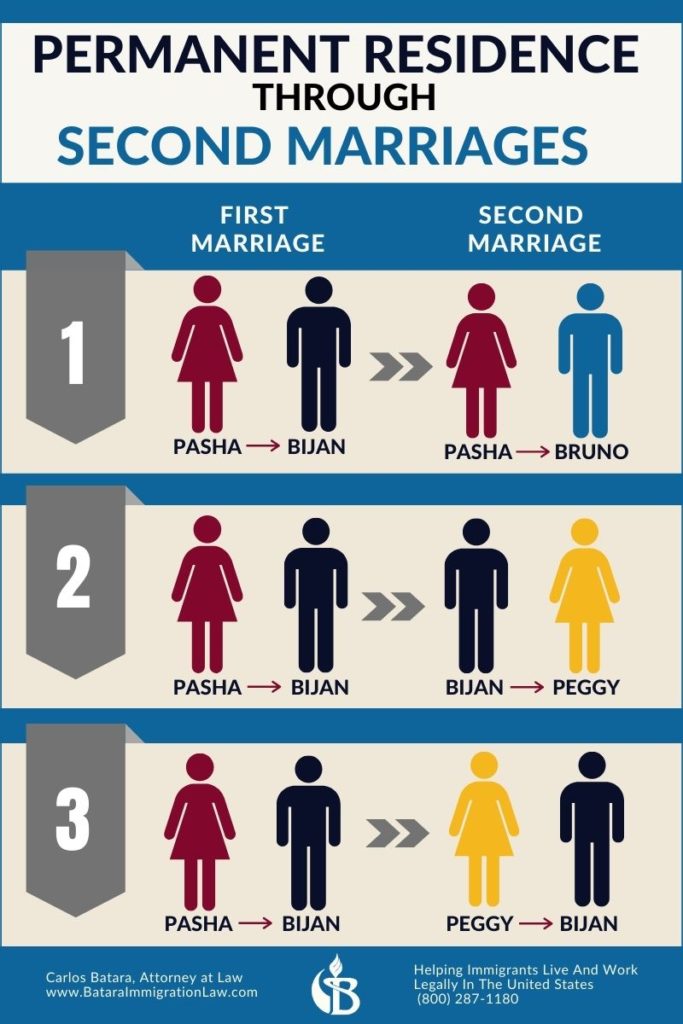
In general, there are three green card through remarriage situations that arise most often:
- A U.S citizen petitions an immigrant spouse for permanent residence. Afterwards, the couple divorces. The citizen remarries and files a petition for his or her new immigrant spouse.
- A U.S. citizen petitions an immigrant spouse for permanent residence. Afterwards, the couple divorces. The immigrant, who is now a permanent resident, remarries and files a petition for his or her new spouse, who is also an immigrant.
- A U.S. citizen petitions an immigrant spouse for permanent residence. Afterwards, the couple divorces. The immigrant remarries. The new U.S. citizen spouse files a petition for the immigrant spouse.
The chart below illustrates these three types of remarriage situations.
The following names have been added to further clarify the charts.
Wives
- Pasha – First Wife
- Peggy – Second Wife
Husbands
- Bijan – First Husband
- Bruno – Second Husband
Now let’s take a deeper look at each situation.
1. Why Do Immigrant Petitions For A Second Spouse Lead To Heightened Scrutiny?
Singing about remarriages, a popular rock group claims, the second time around is better than the first time.
Not necessarily in the eyes of the U.S. government. A citizen’s second marriages is looked at closer than the first marriage, and the first marriage must be fully evaluated once again.
The reason is two-fold. As explained in Eight Green Card Marriage Mistakes To Avoid, the primary two questions which couples must address are:
- Is the marriage legal?
- Is the marriage real (“bona fide”)?
(a) Failure To Show Termination
Of Prior Marriage
The first requirement mandates that both individuals are free to marry and their marriage is recognized as valid in the country where it took place.
Perhaps the most common reason that couples cannot prove a bona fide relationship is the failure to show their earlier marriage is truly ended.
This happens more frequently with foreign divorce decrees.
Take Cesar and Laura. He filed an I-130 petition to immigrate her. At the interview, the USCIS officer informed him that his proof of divorce from the Dominican Republic was inadequate.
(This result can also take place if the beneficiary, the immigrant spouse, does not have authentic verification of dissolution.)
This problem, of course, can also plague petitioners or beneficiaries who were previously married and divorced within the United States.
Walter was one such client. By the time he visited my San Bernardino immigration office, his case was a mess.
He had sponsored his second wife for permanent residence benefits. At the interview, he could not provide an official dissolution certificate from his first marriage.
His second marriage was invalid.
His current wife, lacking lawful status, was placed in deportation proceedings at immigration court.
He had assumed he was officially divorced about seven years beforehand.
Walter’s first wife had filed for the divorce, after their separation. They both moved to other states. He was served with the dissolution papers, which he did not contest. Nor did he keep a copy.
He could not locate his first wife. He did not know what state his divorce took place in. He had committed a major mistake of pro per clients who handle their own cases.
(b) Government Vulnerability To
Fraudulent Marriages
The second requirement means that both of your marriages were based on love, and not for the purpose of helping an immigrant of receiving a green card.
Seems obvious, doesn’t it?
Unfortunately, there are individuals who deliberately engage in marriage fraud.
Liana Barrientos married 10 times, with nine of her marriages occurring during a three-year period. She was married to eight different men at one time. Upon marriage, they filed for permanent residency.
Seven of the men were from countries on the Department of Homeland Security watch list, including Egypt, Turkey, Georgia, Pakistan, and Mali. One husband was deported in 2006 due to his alleged ties to known terrorist groups.
She was convicted and sentenced.

2. When Can A Permanent Resident Sponsor A New Spouse For Green Card Benefits?
In general, an immigrant who obtained lawful permanent resident status through marriage, who divorce and remarry, must wait five years from the date their green card status was granted before an I-130 family based petition for a new spouse will be approved.
The main impetus for this five-year moratorium is to discourge marriage fraud.
The primary exception to this rule, however, renders the rule nearly obsolete for couples with strong evidence.
Lawful permanent residents can file for their new spouses within the five-year period if they can demonstrate by “clear and convincing evidence” that their prior marriage was not the product of immigration fraud.
This means you can expect the government to rigorously review the circumstances of your first marriage and divorce before granting legal status to your new spouse.
After five years, a permanent resident’s petition for the new spouse is allowed. Even though the government will still look into both marriages, the level of suspicion and investigation is lower.
(A second exception to the five year rule is if the first marriage ended due to the death of the immigrant’s first spouse.)
As a green card attorney, I have found the five-year rule is more stringently imposed when a lawful permanent resident seeks to immigrate someone with whom they had a romantic relationship prior to their first marriage.
For example, this occurs when an immigrant enters the U.S. on a temporary visa to attend school or work, falls in love with and marries a United States citizen. The immigrant wins permanent residence based on the marriage. A few years later the marriage falls apart and the couple divorces.
Subsequently, the immigrant is reunited with his ex-sweetheart, who is also an immigrant. This time they decide to marry. He files a spousal petition for his new wife. Because he has not been a permanent resident for five years, the petition is certain to raise red flags based not only on his prior marriage, but also their previous relationship.
Depending on the couple’s home country and religion, government agents are also likely to look into the possibility of polygamy.
3. How To Deal With Allegations Of Past Immigration Marriage Fraud
The danger of a marriage fraud finding is nearly insurmountable. Known as the Marriage Fraud Bar, it can prevent an immigrant spouse from ever winning a green card.
Often, the basis of marriage fraud in past relationships is built on mere suspicions, not actual findings, due to incomplete information on applications or contradictory answers given by husbands and wives at a Stokes interview where each person was questioned separately.
Such a threat is heightened for a husband or wife in their second marriage. As they seek to become a lawful permanent resident through a new spouse’s I-130 petition, their path to a green card is blocked based on the accusations of marriage fraud in their first marriage.
This can occur even if the government thinks your remarriage is legitimate and authentic. Perhaps you and your current spouse were married over 10 years ago. You have three children together. You have more than ample financial proof that your marriage is bona fide. It will not overcome allegations that your first marriage was a fraudulent attempt to obtain a green card.
Worse, you may be referred to immigration court to face deportation charges and family separation.
Unless the government’s allegations of past marriage fraud can be refuted.
How?
By showing the previous marriage was in good faith.
(a) Why Immigrant Spouses Are Caught Off-Guard About Past Charges Of Marriage Fraud
In many instances, the immigrant is unaware of the fraud claim until the I-130 petition for the second marriage has been filed. Expecting an approval notice, the couple receives a Notice Of Intent To Deny (NOID) noting the existence of evidence showing the immigrant spouse had attempted to previously enter into a sham marriage.
I’ve consulted with many individuals, in my capacity as an immigration appeals lawyer, who were totally clueless about the prior marriage fraud finding.
This frequently happens when the immigrant spouse and her first husband decide to go their own ways – after a visa petition has been filed on her behalf but before USCIS has rendered a decision.
In some cases, the U.S. citizen withdraws the petition. Other times the parties simply fail to respond to the government’s request for more evidence pertaining to the bona fide nature of their relationship.
Another common situation occurs when the couple has been married for less than years after the immigration spouse was granted conditional permanent resident status. The couple separates. The I-751 petition to remove conditions, which is supposed to be filed jointly, is ignored by the immigrant spouse.
Or they show up for the permanent residence interview, despite their separation, and try to gloss over their differences and are ill-prepared to answer questions or start bickering. The government schedules a second interview to clarify the discrepancies. They do not attend.
Because the decision is mailed to the last known address of the parties, if the immigrant spouse has moved out, he or she never receives the notice.
In other cases, the citizen and immigrant spouse are aware the USCIS decision is based on sham marriage allegations. Yet, in spite of having entered into a good faith marriage which only later disintegrated, and perhaps became acrimonious, neither party perceives any reason to invest time or money to dispute the reason for the denial.
Years later, when the new visa petition is filed, the immigrant spouse is shocked to learn about the marriage fraud accusations.
(b) To Counter A Marriage Fraud Finding, You Must Prove The First Marriage Was Based On A Bona Fide Relationship
The good news is that a fraud finding based on the earlier petition can be opposed.
To counter a fraud finding, immigrant spouses must demonstrate the previous marriage was genuine. They must convince USCIS that they did not attempt to skirt the law for a green card.
If USCIS denies the petition despite the evidence submitted, couples may need to consider appeals or I-290B motions to reopen or reconsider.
This is not an easy hill to climb. Nearly all couples will need an immigration appeals attorney to assist them in overcoming the government’s claims.
USCIS regulations state that a visa application will be denied when there is substantial and probative evidence of marriage fraud, even though the immigrant did not receive a benefit through the attempt or conspiracy.
The regulations add, “evidence of the attempt or conspiracy must be contained in the alien’s file.”
However, USCIS is not supposed to give conclusive effect to determinations made in prior proceedings. Rather, the agency is required to reach an independent conclusion based or the evidence before them at the present time.
This means the government must evaluate the evidence anew rather than solely rely upon a previous decision. This allows immigrants a chance to rebut the earlier finding.
To offset the government claim of marriage fraud, here are some steps you should take:
- Identify the basis of the government’s allegations
- Locate and organize evidence that contradicts USCIS reasoning
- Reach out to your former spouse for a supporting affidavit
- Request statements from witnesses with first hand knowledge regarding your earlier relationship

(c) Types Of Evidence To Challenge Denial Of Your Previous I-130 Petition Based On A Finding Of Marriage Fraud
The first step in fighting back against sham marriage allegations is to identify the basis of the government’s allegations.
This usually requires immigrants to obtain copies of the I-130 immigrant visa petition and I-485 permanent residence application filed in their past marriage – and the denial notices.
Generally, the most critical document, the I-130 denial, is the toughest to procure.
Because the I-130 denial is mailed to the petitioner, not to the immigrant, immigrants often have to reach out to their former spouses to obtain this document. For many immigrants, this step is often emotionally distasteful. However, for most, such an endeavor is crucially important. Without knowing the reasons why USCIS alleged marriage fraud, your odds of successfully appealing the earlier determination are greatly reduced.
Much like you would never enter a sword fight blindfolded, why would you risk losing your challenge to the fraud allegations because you do not want to speak to your ex-spouse? (Besides maybe another family member, or even your lawyer, can do the reaching out.)
For instance, one individual sought our help because the petition he filed for his wife who still lived in her home country had been denied on suspicion of a fraudulent marriage. When we obtained the records relied on by the government, they showed that her first husband, while she was waiting abroad for her interview, had been living with another woman and had two children. Neither woman had any clue about the other.
The government was correct to challenge the legitimacy of her first marriage. But it was a deceitful act committed by the U.S. spouse, without the immigrant spouse’s knowledge. If her records had not been obtained, her chances of overcoming the allegations would have been far more difficult, if at all possible. Until we were able to examine the USCIS file, she had no inkling about her husband’s other relationship.
Here’s the moral to the story.
If you’re facing charges pertaining to a fraudulent marriage, always, always, always find out exactly why the government thinks your marriage is not bona fide.
In most cases, USCIS will look at evidence like shared financial assets and debts. Do you have joint bank accounts? Do you have credit cards in both names? Do telephone, trash, and other similar household expenses reflect both you and your spouse live at the same address with co-responsibility for payment?
Rent and mortgage contracts are relevant for this same purpose. Copies of your federal and state tax statements are likewise useful. So is information like car ownership documents, insurance policies, and work-related health benefit records.
To the extent such evidence does not reflect both of you and your former spouse’s names, a well-written affidavit, submitted under penalty of perjury, should be submitted explaining the reasons for the lack of jointly-held assets, debts, invoices, and the like.
It is not uncommon for couples, who enter a marriage with their own careers, income, and assets, to want to keep expenses separate. They divide payments and make them on an individual, not joint, basis. This is the type of situation where a well-written description will help dispel the government’s suspicions of marriage fraud in the earlier marriage.
In yet other cases, USCIS officers suspect marriages are an attempt to circumvent the law based on red flags such as age, race, religion, education, culture, social class, as well as English language fluency differences. Here, again, well-written affidavits can be a useful tool to offset government fears of fraud – especially those written by persons who had close and direct relationships with the immigrant and her ex-spouse.
These tips are, by no means, exhaustive. Because each case is different, the evidence that will assist immigrants defeat fraud allegations will differ.
The better evidence you provide, the more proof you submit, will enable immigration authorities to obtain a clearer picture of your past relationship. This, in turn, will help reduce USCIS doubts and provide government officers with greater insight why their suspicions about your first marriage were misplaced.
Frequently Asked Questions About Remarriage And Green Cards
Can I get a green card through a second marriage?
Yes. A prior divorce does not prevent you from obtaining lawful permanent residence through a new marriage. However, when either spouse was involved in a prior marriage-based immigration petition, USCIS may examine both the current and earlier relationships to determine whether each was genuine.
Will USCIS investigate my first marriage?
Often, yes. USCIS always considers previous marriages as part of the review process. Officers will assess prior petitions, interview notes, divorce records, and earlier decisions in depth if any questions arose in your earlier case whether it was based on a bona fide relationship.
What is the Marriage Fraud Bar?
The Marriage Fraud Bar, found in INA § 204(c), prevents approval of any future family-based petition if USCIS determines that an immigrant previously entered into or attempted to enter into a marriage for the purpose of evading immigration laws.
Can USCIS deny my current case even if my present marriage is genuine?
Yes. A current marriage may be entirely legitimate, but USCIS can still deny the petition if it concludes that a prior marriage was fraudulent. Allegations relating to an earlier relationship can therefore affect an otherwise approvable case.
What is the five-year rule for permanent residents who remarry?
A lawful permanent resident who obtained green card status through marriage generally must wait five years before a new petition for a subsequent spouse can be approved. An exception applies if the resident proves by clear and convincing evidence that the prior marriage was genuine.
What does “clear and convincing evidence” mean?
This is a heightened evidentiary standard. USCIS expects substantial proof showing that the prior marriage was real, including joint financial records, tax returns, photographs, correspondence, affidavits, and other documents demonstrating a shared life together.
Can a prior marriage fraud allegation be challenged?
Yes. If a prior determination adversely affects a current petition, USCIS cannot simply defer to the earlier decision. Rather, couples are entitled to a new independent review of that past determination. Immigrants can submit documentation and affidavits to rebut allegations that an earlier marriage was fraudulent – and a well-prepared challenge can make a difference in the outcome.
What if my former spouse refuses to cooperate?
Although cooperation from a former spouse can be helpful, it is not always necessary. Other documents and witness statements may be sufficient to establish that the prior marriage was entered into in good faith.
What should I do if my remarriage-based petition is denied?
Depending on the circumstances, your options may include filing an appeal, submitting a Form I-290B motion to reopen or reconsider, or re-filing with stronger evidence. The most effective course of action depends on the reasons for the denial and the evidence available to address USCIS concerns. Given the complexity of marriage fraud allegations, consulting with an immigration attorney before responding to a denial is strongly advisable.
Can A U.S. Citizen Be Questioned About A Prior Petition Filed For A Different Spouse?
Yes. When a U.S. citizen or lawful permanent resident files a marriage-based petition for a new spouse, USCIS may review earlier petitions to determine whether the prior marriage was genuine and whether any inconsistencies or fraud concerns were raised. Neither U.S. citizens nor lawful permanent residents are immune from suspicions that a prior marriage was entered into solely to obtain immigration benefits.
Review And Update
This page has been reviewed by Carlos Batara, a Harvard Law School graduate and immigration attorney who has represented immigrants and their families for over 30 years in complex immigration cases, appeals, and post-denial strategies, including second marriage-based immigration filings and marriage fraud allegations.
Last updated: May 2026
Second Marriages, Second Chances
If you ever get a second chance in life for something, Lance Armstrong, the famous cyclist once said, you’ve got to go all the way.
For relationships involving at least one spouse with a past divorce – in which the marriage included a failed effort to immigrate an immigrant husband or wife – this advice is critical if government claims of marriage fraud arise during the green card process.
You can overcome such allegations. But you’ll need to go all in.
May the force be with you.
Remarriage Green Card Assistance Throughout Hemet, San Bernardino County, And Riverside County
A second marriage-based immigration filing does not automatically mean your case will be denied.
But it does mean USCIS may look more closely at both your current and prior marriages.
In many situations, what you do next can directly affect the outcome. A carefully prepared filing can strengthen your case and help address concerns about prior marriage fraud, the five-year rule, or the Marriage Fraud Bar.
Depending on the circumstances, the right approach may include:
- Reviewing prior I-130 petitions, I-485 applications, and USCIS decisions
- Obtaining records relating to earlier denials or fraud allegations
- Gathering evidence showing that a prior marriage was bona fide
- Preparing affidavits from former spouses, relatives, and other witnesses
- Addressing the five-year rule for lawful permanent residents petitioning new spouses
- Responding to Requests for Evidence or Notices of Intent to Deny
The key is not simply submitting documents, but presenting a well-organized filing that directly addresses the government’s concerns.
Careful legal guidance can help you identify the issues in your case, avoid common mistakes, and present the strongest possible evidence in support of your petition.
If you need assistance with a remarriage-based immigration case, learn more about our regional offices and service hubs:
No matter where you live, we are committed to protecting your rights, exploring every available option, and helping families remain together whenever the law allows.
Nationwide Representation: Many clients also choose to work with our office remotely through our Virtual Immigration Law Office, enabling individuals and families across California and the United States to receive experienced immigration representation without needing to travel for in-person meetings.
Looking for assistance with a remarriage-based green card case, prior marriage fraud allegations, or the Marriage Fraud Bar? Schedule a personalized strategy and planning session today.