Confidential legal support for domestic violence survivors seeking lawful immigration status and independence through a VAWA self-petition.
Led by Harvard Law School graduate and immigration attorney Carlos Batara, our office handles VAWA cases with both the experience these deeply personal matters require and the compassion those who have endured abuse deserve.
Even If You Have Been The Victim Of Domestic Violence
We Can Help You Fight Deportation And Become A Permanent Resident
Are you now or have you been in an abusive relationship with a U.S. citizen or lawful permanent resident? If so, immigration law provides a path to safety and legal status.
As a victim of abuse, you may feel trapped, forced to remain living with your U.S. citizen or permanent resident spouse.
Due to your lack of immigration papers, you might think there is no way out.
Through the Violence Against Women Act, you can seek a green card without relying on your abuser.
Many survivors minimize what happened to them or believe, because there was no police report, they do not qualify. In my experience, such assumptions are frequently incorrect — both legally and factually.
This page explains what VAWA is, who qualifies, and what types of evidence you need to support your self-petition.
Confidentiality Matters: Your abuser will not be notified of your VAWA filing.
You Are Not Trapped: Immigration Options Exist for Abused Immigrants
The abuse many immigrants face takes many forms.
For instance:
- Perhaps your permanent resident spouse physically beats you, doesn’t allow you to have any friends, and refuses to file immigration papers to petition you for a green card.
- Maybe your U.S. citizen spouse divorced you yet continues to call you insulting names, won’t give you any child support, and threatens to call the police to deport you.
- Or as the oldest child, you have watched your legalized parent physically attack your mother as well as verbally and emotionally mistreat you and your younger sister.
However severe the domestic violence you’ve experienced, you don’t need to give up.
With or without your spouse, there are options to help you and your children.
With or without your spouse, you can fight deportation.
With or without your spouse, you can win permanent residence.

Table Of Contents
-
- What Is The Violence Against Women Act?
- Who Qualifies To Self-Petition For VAWA?
- Requirements For VAWA Self-Petitions
- What Types Of Evidence Do You Need To Qualify For A VAWA Green Card?
- How To Prove Extreme Cruelty In VAWA Cases
- How VAWA Protects Immigrant Spouses And Children Trapped In A Web Of Abuse
- Don’t Let Common Misconceptions Prevent You From Filing For VAWA
VAWA Self-Petition Process (Step-By-Step Overview)
While every self-petition is different, most VAWA I-360 applications follow this general process:
1. Confirm self-petition eligibility under the Violence Against Woman Act program
2. Prepare personal declaration and obtain witness statements, if any
3. Obtain supporting evidence like counseling reports, medical reports, police reports
4. File the VAWA application with supporting evidence packet
5. Respond to any USCIS requests for evidence in timely and thorough manner
6. USCIS issues a decision granting or denying the VAWA application
7. Additional options may exist, including motions, refiling, or petitions at immigration court
What Is The Violence Against Women Act?
The Violence Against Women Act (VAWA), passed by Congress in 1994, provides special protection for both immigrant spouses and children who have suffered battery or extreme cruelty at the hands of a United States citizen or lawful permanent resident.
Although victims of domestic violence are usually female, the Act also covers abused male spouses and children.
This means if your husband, wife, father, mother, stepfather, or stepmother, who is a U.S. citizen or lawful permanent resident, has abused you or your child physically, sexually, or psychologically, you are entitled to file for permanent residence benefits under VAWA.
Despite political opposition, the program has been extended several times. It was most recently reauthorized to 2027. At that point, it will once again go through Congressional review.
Recent USCIS policy updates, noting an increase in the number of VAWA filings, both legal and fraudulent, have stressed a more rigorous evaluation of I-360 self-petitions, making thorough preparation essential before submission.
Because of increased scrutiny, poorly prepared or rushed filings are more likely to receive detailed Requests for Evidence. Careful preparation at the outset can reduce avoidable complications later in the process.
Although this article is focused on abused spouses and children, a parent mistreated by an United States citizen adult son or daughter may also qualify for a VAWA green card.
Who Qualifies To Self-Petition For VAWA?
Although VAWA stands for the Violence Against Women Act, its protection is not limited to immigrant women.
The following persons are eligible to file self-petitions under VAWA:
- Abused or battered spouses of U.S. citizens or lawful permanent residents. This includes abused and battered male spouses.
- Spouses of U.S. citizens or lawful permanent residents who are not abused, but whose children are abused.
- Abused or battered male and female children of U.S. citizens or lawful permanent residents.
- Parents who are abused by their U.S. citizen adult son or daughter
Requirements For VAWA Self-Petitions
To qualify for a VAWA self-petition, you generally must show:
- A qualifying family relationship to the abuser
- The abuser was a U.S. citizen or lawful permanent resident at the time of the abuse
- Battery or extreme cruelty during the qualifying relationship
- Residence, past or present, with the abuser at some point
- Good moral character
- Credible supporting evidence that is relevant to your case
Satisfying these criteria does not guarantee automatic approval. USCIS reviews the totality of the evidence submitted and exercises discretion when adjudicating VAWA petitions. Thus, thorough documentation and careful petition preparation are critical to success.
In practice, favorable discretion turns on credibility and consistency. Officers look closely at how the declaration, supporting documents, and third-party statements align. Small inconsistencies can raise concerns if they are not explained clearly.
Discretionary standards require careful interpretation and precise documentation. A petition should anticipate how adjudicators apply those standards in practice.
What Types Of Evidence Do You Need To Qualify For A VAWA Green Card?
As noted earlier, many immigrant victims of domestic violence believe they don’t qualify for VAWA protections. This often comes from fear that they lack enough evidence to support their claims.
Although each case is unique, the types of evidence are relatively similar. These include client declarations, counseling records, medical records, protective orders, police reports, and statements from third-party witnesses.
Nor is physical abuse an absolute requirement under VAWA. You can win if you have been subjected to extreme cruelty.
How To Prove Extreme Cruelty
In VAWA Cases
Extreme cruelty includes actions like control, intimidation, emotional harm, humiliation, immigration threats, and psychological coercion.
Let’s take a look at some examples of extreme cruelty:
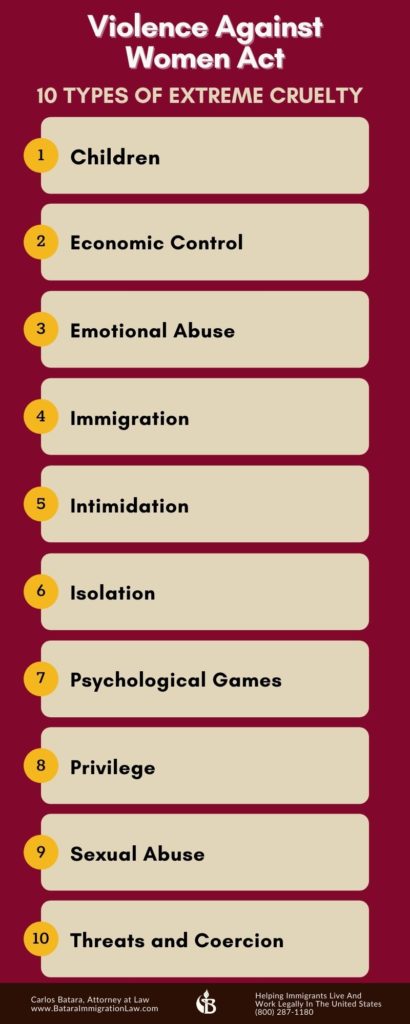
Children
- Threating to take the children away from you
- Questioning the kids about what you did all day while the abuser was at work
- Yelling and screaming at the kids, punishing kids excessively
Economic Control
- Controlling all the money, credit cards, and bank accounts
- Not giving you any money to spend without permission
- Keeping your name off bank accounts, rental agreements, and utility bills
Emotional Abuse
- Calling you names and putting you down in front of other people
- Putting down your culture, country, language, or race
- Opening and reading all your mail before giving it to you
Immigration
- Refusing to file papers to legalize your status
- Threatening to withdraw your immigration papers
- Destroying important immigration documents
Intimidation
- Smashing things, throwing things
- Kicking, hitting, harming your pets
- Driving crazy to scare you
Isolation
- Limiting you from the use of the telephone
- Preventing you from visiting or speaking with family members
- Prohibiting from letting you work, go to school, or learn English
Psychological Games
- Threatening to report you or the kids to ICE
- Making you dependent on the abuser for transportation
- Threatening to report you for “working under the table”
Privilege
- Treating you like a servant
- Making you dependent on the abuser for transportation
- Making you feel guilty about the children when they act up
Sexual Abuse
- Having relationships with other women or men
- Accusing you of sleeping with other people
- Calling you names like “prostitute”, “mail order bride”
Threats And Coercion
- Threating to leave you, divorce you
- Making you commit criminal acts
- Threatening to hit you, punch you, slap you
If you have been mistreated in these types of ways, you have a chance to win VAWA benefits.
Of course, documenting such facts is difficult.
The goal is to document the pattern of abuse with whatever records exist – counseling reports, medical reports, police reports, witness statements, and communications between the party.
Extreme cruelty cases often succeed or fail based on how the psychological impact is documented. General statements are rarely persuasive. Specific examples, supported by evaluations or corroborating witnesses when available, tend to be far more effective.
Even when there are no police or medical reports, VAWA cases can be won through credible declarations supplemented by corroborating psychosocial evaluations.
Here is the reality. In many of the VAWA cases I have handled, approval depended less on the presence of a police report and more on whether the pattern of abuse was explained in a clear, chronological, and coherent manner. In short, a well-structured declaration carries significant weight – and the more credible corroboration you can provide, the better.
Be aware however, it is not uncommon for immigrant spouses to submit police reports and divorce court records in hostile breakups that have the opposite effect they intended.
This is why you may need professional assistance to help gather, organize, and present the proof required for success.
How VAWA Protects Immigrant Spouses And Children Trapped In A Web Of Abuse
If you’re a battered or abused immigrant – female, male, or child – there are three distinct ways you can seek benefits under the Violence Against Women Act.
- Self-Petitions For VAWA Green Cards – VAWA is a special immigration program that allows you to file a self-petition, based on your family relationship, to obtain green card benefits on your own without your abuser’s consent
- Immigration Court Deportation Defense – You can use special VAWA Cancellation of Removal rules to fight against being deported at immigration court hearings. More in-depth discussion of how the history of domestic violence is assessed in proceedings is available on VAWA Cancellation of Removal page.
- Modify Conditional Residency Status – You can independently seek to remove the two-year restriction on your card status due to domestic abuse, if your spouse abandons or refuses to help you before the limit on your conditional permanent residency expires.
In addition, if your self-petition is approved, you can obtain a work permit – while you’re still waiting for your VAWA interview to become a permanent resident.
And once you’re granted a green card, the wait for VAWA recipients to seek citizenship is only three years.
Other than showing abuse and victimization, the rules for the various abused individuals – spouses, parents, and children – are vastly different. This means immigrants who seek VAWA protection need to carefully review the regulations which apply to their situation.
Don’t Let Common Misconceptions
Prevent You From Filing For VAWA
Quite often, victims do not file VAWA applications because they are misinformed about its requirements. Here is a list of the most common misconceptions about VAWA cases:
- VAWA benefits are only available to women. This is incorrect. Males and children (including male children) can seek protection under VAWA.
- The abuse must be physical. Not true. Although physical harm and battery are strong indicators of domestic abuse, many victims qualify each year for VAWA benefits based on primarily psychological victimization.
- There must be a police report to seek VAWA protection. Although police reports, restraining orders, hospital records, and victim counseling treatment are important evidence to demonstrate domestic violence, they are not required to file or prove eligibility for a favorable grant of VAWA benefits.
- VAWA applicants need to be divorced. Spouses who have been victims do not need a divorce or separation to file a Violence Against Women Act application. A divorce, in fact, can undermine a victim’s eligibility for benefits under VAWA in some cases.
Do not let these misunderstandings deter you from applying for VAWA.
While your VAWA application is being processed, you have the right to stay with or leave the abuser. It’s your decision, and your decision alone. Without pressure from your spouse or parent.
The whole process is completely confidential and private.
Your abusive spouse – or ex-spouse – will never be told about your VAWA petition.
And if you use the services of a VAWA immigration lawyer, the government will not contact you directly.
Additional Immigration Services
For an overview of all immigration matters we handle, in addition to our services under the Violence Against Women Act, visit our Immigration Legal Services page.
Timing Matters In VAWA Cases: Why You May Need To Act Now
How a VAWA case is built from the beginning has a significant impact on the outcome. The history of the relationship, the pattern of abuse, and the supporting documentation all need to be developed in a way that satisfies legal requirements and tells a complete, accurate picture of what took place.
Details that seem minor at first may become more important once the government begins reviewing your claim. Incomplete records can lead to requests for additional evidence, delay a decision, or create complications that put the entire case at risk.
Thorough preparation from day one helps ensure that every claim is backed by well-developed, credible proof.
Taking The Next Step In Your VAWA Case
If you have experienced abuse and your immigration status remains uncertain, your first step is determining whether a VAWA self-petition is the right path for your situation.
No two cases are alike. The nature and history of the relationship with your abuser, together with the available evidence, shape how the matter must be presented.
Speaking with an immigration attorney can help clarify your options, identify potential obstacles, and determine how best to move forward towards permanent residence.
Frequently Asked Questions About The Violence Against Women Act
Can I file a VAWA self-petition if my abusive spouse never filed papers for me?
Yes. Whether or not a petition was filed for you, you can file a self-petition with USCIS. Your self-petition is submitted using Form I-360. It does not require your abusive spouse to have previously filed an immigration petition on your behalf. Such a requirement would defeat the purpose of the VAWA statute. The abuser often refuses to file an immigration petition as a means of control.
Does VAWA protect immigrant men who experience domestic abuse?
Yes. VAWA protections cover survivors of any gender, including male spouses and children who have suffered extreme cruelty. This is one of the common misconceptions of immigration law. The forms of the abuse suffered by males usually differ from those suffered by females. Learn more about VAWA protections for male victims and how the law applies in these cases.
Do I need a police report or protective order to qualify for VAWA?
No. While police reports and protective orders are valuable evidence, they are not required for a successful VAWA self-petition. The absence of such evidence means a VAWA applicant will need to ensure they provide a strong declaration under penalty of perjury supplemented, to the fullest extent possible, with solid corroborating evidence like witness statements and medical, counseling, or psychological reports.
What counts as a qualifying relationship for VAWA?
Qualifying relationships include abused spouses, children of abusive parents, and parents abused by their adult U.S. citizen or lawful permanent resident son or daughter.
Can I include my children in my VAWA self-petition?
Yes. Children abused by the same abuser can be included in your application if they meet the qualifying requirements. Children subjected to domestic violence are also eligible to file their own petitions. Additional insight regarding VAWA relief for abused children is available here.
If my self-petition is approved, what benefits can I get?
Approval allows you to apply for a green card. During the period of time while a decision on your I-360 petition is pending, USCIS often issues a prima facie determination. This provides abuse victims the opportunity to seek work authorization and temporary protection against deportation. Eventually, after being permanent resident status under VAWA and meeting residency requirements, you are entitled to pursue citizenship.
Can VAWA help me if I’m in removal proceedings?
Yes. In immigration court, you may seek VAWA Cancellation of Removal as a defense against deportation. There are various requirement differences, such as the two-year limitation after divorce which does not apply in removal proceedings.
Is my VAWA petition really confidential?
Yes. Your VAWA petition is confidential. Your abuser will not be notified of your filing by USCIS.
If I have been abused, but I was never married, can I still file for immigration benefits under a self-petition under VAWA?
No. There is a possible alternative. You may be entitled to file for a U Visa, as the victim of a crime and were helpful to law enforcement in the investigation or prosecution of that crime. You can read more about the differences between these options on our VAWA vs. U Visa page.
There is also a possibility that if you and the abuser lived in a state that recognizes common law marriages at any time, you might qualify as a spouse under the Violence Against Women Act.
Can I qualify for VAWA if I believed I was legally married, but later discovered the marriage was not valid?
Yes, in some cases you may still qualify. VAWA protects certain “intended spouses” who entered into a marriage in good faith and believed the marriage was legally valid, but later discovered it was not. This often occurs when the U.S. citizen or lawful permanent resident spouse was already married to someone else at the time of the ceremony.
To qualify as an intended spouse under VAWA, you must show that:
- You entered the marriage in good faith
- You went through a marriage ceremony you believed was legitimate
- You were unaware that your spouse’s prior marriage made your marriage legally invalid
Reviewed by Carlos Batara, VAWA Immigration Attorney
Serving clients through our Hemet headquarters, throughout Riverside County and San Bernardino County, and nationwide through virtual representation.
Last updated: February 2026
Unlocking Justice: Helping Immigrants Win Difficult VAWA Cases Together
Violence Against Women Act cases are a unique type of immigration family services.
Although it is based on a family relationship, you can file for immigration benefits without a family member to sponsor you.
If the truth be told . . .
More often than not, trying to do this on your own is a bad idea. One mistake can ruin your chance for success. If you lose, you may be placed in immigration court to face deportation charges.
Domestic violence is not easy to discuss for most victims.
But if you have been abused, in order to win, you need to present your case with careful detail. You cannot afford to hold back the truth.
Because your paperwork has to be accurately prepared – and your evidence strongly laid out – you need to find an immigration attorney who makes you feel comfortable when you share painful moments you’d rather forget.
Teamwork is crucial in VAWA cases.
You are not required to hire an attorney to help you.
Here’s what you must consider if you are thinking about handling your case on your own.
Your decision should be based on your knowledge of immigration regulations, your ability to prepare the evidence required for success, and your inner strength to push forward even if the government challenges the authenticity of your claims.
If you decide you need help . . . we’re here to assist you.
Before filing a VAWA self-petition, it is wise to review your situation carefully. Immigration cases centering on domestic violence require thoughtful strategy — not only to establish eligibility, but to anticipate how the government may evaluate the evidence presented.
Breaking Chains, Healing Lives: Nationwide Services For Domestic Abuse Victims
If you or a loved one is experiencing abuse and uncertainty about immigration status, you do not have to navigate the VAWA process alone.
For over three decades, Batara Immigration Law has represented numerous abused immigrants seeking protection and lawful status under the Violence Against Women Act nationwide through our private virtual immigration law office. In-person services are also available for clients in Southern California
Each case is handled with confidentiality, care, and a clear legal strategy tailored to the survivor’s circumstances.
Our ofice focuses on complex VAWA cases involving self-petitions, family-based green card pathways, and defense against deportation.
This often requires navigating the intersection of immigration law with family court and protective order proceedings – allowing VAWA protections to be coordinated with other legal safeguards for battered spouses and children when necessary.
The bottom line: to guide clients from situations of domestic abuse toward safety, stability, and lawful permanent residence in the United States.
VAWA Immigration Support Throughout Hemet, San Bernardino County, And Riverside County
Are you a victim of domestic violence?
VAWA immigration petitions offer protection and a path to lawful status in the United States. These cases require confidentiality, detailed documentation, and caring representation.
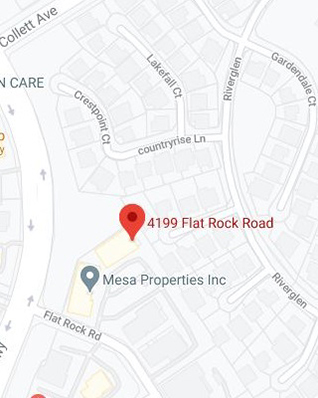
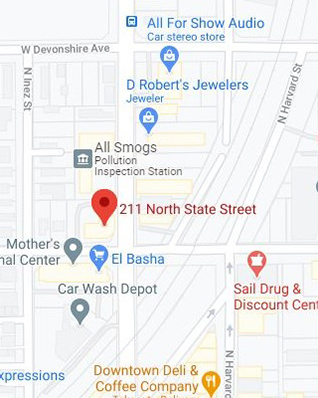
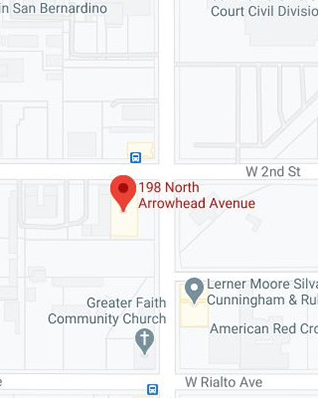
We’re here to help. Our office assists VAWA clients in moving forward safely and independently through our regional service hubs, including:
No matter where you live, we are committed to providing confidential, compassionate legal support. Let us help guide you on the path to lawful permanent residence.
Many clients choose to work with our office remotely through our Virtual Immigration Law Office, allowing individuals and families across California and the United States to receive experienced immigration representation without needing to travel in person.
If you’ve been the victim of domestic violence, now or in the past, and you want to explore your immigration options, schedule your confidential strategy and planning session today.