To win an I-601 or I-601A waiver, immigrants must show that a denial will lead to extreme hardship to a qualifying relative. This hardship usually results from the combination of a wide range of factors, such as health, finances, family relationships, education, employment, and other circumstances.
Country conditions are another potentially important part of the extreme hardship assessment. When an immigrant has to reside outside the United States, conditions in the country where the immigrant will live can affect the qualifying relative in adverse ways.
By itself, evidence of country conditions does not establish extreme hardship. Yet, such evidence can help prove extreme hardship in waiver cases.
Batara Immigration Law is led by Carlos Batara, a Harvard Law School graduate and immigration attorney with more than 30 years of experience, handling complex hardship cases, including I-601 and I-601A cases.
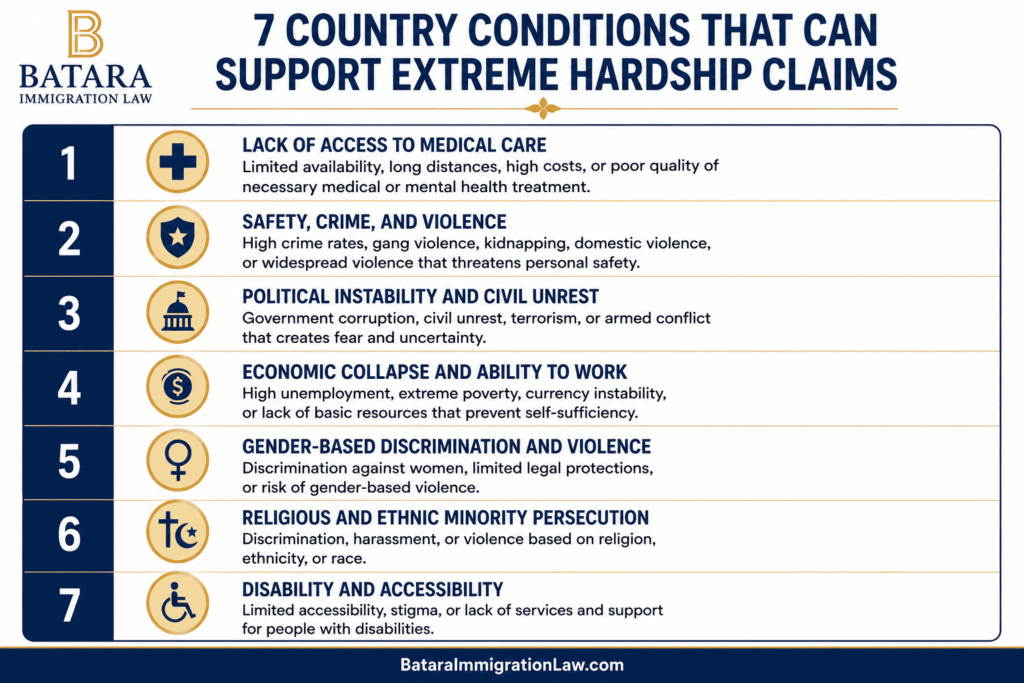
Table Of Contents
- What Country Conditions Can Help Prove Extreme Hardship?
- Why Must Country Conditions Be Connected To The Qualifying Relative?
- Country Conditions That Can Increase Extreme Hardship
- Medical Care
- Crime And Violence
- Political Instability And Civil Unrest
- Economic Conditions
- Gender-Based Discrimination And Violence
- Religious and Ethnic Discrimination
- Disability and Accessibility
- Common Mistakes That Weaken Country Conditions Evidence
- The 5-Step Framework For Using Country Conditions To Prove Extreme Hardship
What Country Conditions Can Help Prove Extreme Hardship?
There is no single type of country condition that automatically establishes extreme hardship.
In general, there are several types of country conditions that are common to many hardship cases. Potentially relevant country conditions include:
• Lack of access to necessary medical or mental health care
• Crime, gang activity, or violence in the specific region
• Political instability, conflict, or civil unrest
• Economic conditions that limit employment or income
• Gender-based discrimination and violence
• Persecution of religious or ethnic minorities
• Limited infrastructure for persons with disabilities and accessibility concerns
Different conditions affect different families in varying degrees.
Safety may be the primary concern in one case. Medical care may be far more important in another. For another family, several seemingly unrelated conditions may interact and create much more serious consequences.
Why Must Country Conditions Be Connected To The Qualifying Relative?
The existence of such conditions does not necessarily make them important to a waiver case. It is important to recognize that the impact of country conditions on a qualifying relative is not the same as mere country conditions information. There must be a bridge between the general conditions and the specific relative.
Think of it this way. A qualifying relative’s declaration tells an officer what they believe will happen to them because of certain country conditions. Country conditions evidence tells the officer what has already happened, or is happening, to others facing similar circumstances. One is testimony. The other is corroboration. Strong country conditions presentations have both.
If your qualifying relative has a chronic illness, don’t just show that the country’s healthcare system is under-resourced. Show that the specific treatment they need isn’t available, or that the wait times make the treatment ineffective, or that the nearest facility offering it is hours from where they’d have to live.
If your qualifying relative is a woman, don’t just cite general reporting on gender-based violence. Show how that violence is documented in the specific region, the specific economic class, or the specific circumstances she would face.
The same principle applies to employment, crime, education, language, family support, transportation, housing, and other conditions.
The crucial country conditions question is not simply: What problems exist in this country?
Rather, the question is: Which of those problems matter to this family, and why?
Country Conditions That Can Increase Extreme Hardship
Country conditions can affect extreme hardship in many different ways. The conditions that matter will depend on the qualifying relative’s individual circumstances and the country or region where the immigrant or qualifying relative would live. Medical care, personal safety, political instability, economic conditions, discrimination, and accessibility are among the conditions that can increase the hardships caused by family separation or relocation.
Medical Care
Country conditions can leave a qualifying relative unable to obtain treatment that keeps them healthy or stable. The existence of hospitals or doctors does not mean the qualifying relative will have access to the care they need. Relevant factors include the availability of specialists, medications, medical procedures, mental health treatment, rehabilitation, and continuing care for chronic conditions.
In some cases, location creates a major hurdle. Specialized treatment may exist in a major city yet not in the region where the qualifying relative would live. Long travel distances, inadequate transportation, or the need to make repeated trips for treatment can make medical care difficult to obtain.
Also, cost is sometimes a separate barrier to care. Treatment might be available but financially beyond the qualifying relative’s reach. Medication, specialist care, or diagnostic testing may be unaffordable, while the country’s health system offers only limited public coverage.
Mental health care can suffer similar problems. A qualifying relative receiving therapy or counseling in the United States could encounter shortages of mental health professionals, limited access to necessary medications, or cultural stigma that discourages such treatment.
These types of medical concerns can also affect a qualifying relative who remains in the United States. Knowing that an immigrant relative’s medical condition cannot be adequately treated abroad can create real anguish, particularly when a condition that would be manageable in the United States is left to worsen due to the absence of available care.
In summary, medical care abroad becomes part of the totality of hardship when the qualifying relative, or the immigrant relative they love, cannot realistically continue receiving the particular care their health requires.
Crime And Violence
Gang activity, extortion, kidnapping, organized crime, or other forms of violence can put a qualifying relative’s personal safety at risk.
Personal factors also affect the degree of potential harm. Age, occupation, household situation, perceived wealth, neighborhood, or connections to the U.S. can increase a qualifying relative’s exposure to danger.
The availability of police protection may also matter to the hardship analysis. Weak or corrupt law enforcement services leave a person susceptible to crime and victimization.
Safety conditions abroad can also contribute to the severity of a qualifying relative’s hardship, even when they remain in the United States. Concern about a spouse living in a dangerous area can increase the emotional consequences of separation. Unsafe conditions make visits to the immigrant’s residence more difficult and interfere with the family’s ability to maintain its relationship across international borders.
Political Instability And Civil Unrest
Government instability, armed conflict, contested elections, demonstrations, curfews, and similar disruptions can interfere with ordinary life in ways that compound over time. Transportation grows unreliable. Businesses and schools close without warning. Access to medical care becomes interrupted. Electricity, water, banking, and other basic services grow less dependable.
Government instability can also interfere with routine administrative needs. Obtaining residency documents, professional licenses, school enrollment, or other government services becomes more difficult when public agencies operate irregularly or cannot function normally.
These problems can interact with hardships already faced by the qualifying relative. A person with significant medical needs may be particularly affected when instability disrupts medical services. Someone who must work may face additional hardship when businesses close or transportation becomes unsafe.
Political instability can also contribute to hardship when the qualifying relative remains in the United States. Unrest or conflict abroad can make it difficult to reach a spouse or confirm their safety, and travel to see them can become unpredictable or unsafe. Communication itself often breaks down during periods of unrest, deepening the strain of separation.
Political instability and civil unrest become part of the cumulative hardship a qualifying relative faces when the turmoil is active and ongoing — whether through the consequences of relocation or the burdens of maintaining a family relationship across borders.
Economic Conditions
A qualifying relative who has developed a career in the United States may encounter limited employment opportunities abroad. Their occupation could pay considerably less, require different licensing or credentials, or offer few opportunities in the region where the family would live.
Finding ways to apply one’s educational and professional training abroad can be difficult. A U.S. degree, professional license, certification, or years of specialized work experience does not always transfer easily to another country’s labor market.
The broader economy matters too. High unemployment, inflation, currency instability, low wages, and rising living costs can affect the qualifying relative’s ability to pay for housing, food, transportation, medical care, education, and other necessities.
Housing can compound these difficulties. Affordable housing may be unavailable in safer areas or near employment, schools, or necessary medical services. A family may have to depend on relatives for housing or accept living arrangements substantially different from those they maintained in the United States.
Relocation may also require the qualifying relative to give up economic stability built over many years. A career, home, business, retirement benefits, savings, or other sources of security in the United States can be difficult to replace abroad. The hardship therefore involves not only what the qualifying relative might earn after relocation, but also what they would have to leave behind.
Economic hardship can also affect a qualifying relative who remains in the United States. Reduced earning capacity or economic instability abroad can leave the immigrant relative unable to contribute financially, or can require ongoing support from the U.S. qualifying relative.
Losing that income, no longer sharing household expenses, or having to cover other living costs alone can create serious financial pressure, particularly where the immigrant was a primary or significant wage earner.
Gender-Based Discrimination And Violence
A qualifying relative can face unequal treatment, abuse, violence, or inadequate government protection because of her sex. The degree of hardship depends on her personal situation, the types of discrimination or violence prevalent in the country or region, and the availability of meaningful legal and law-enforcement protections.
General statistics concerning discrimination or violence against women provide only part of the picture. The qualifying relative’s circumstances affect her vulnerability, including her age, family situation, financial independence, location, availability of family support, and other personal factors.
Gender-based discrimination can affect different aspects of daily life. Women may face unequal treatment involving employment, education, property rights, financial independence, access to services, freedom of movement, or participation in public life. These conditions can become particularly significant when they interfere with the qualifying relative’s ability to establish an independent and stable life after relocation.
Legal protections also do not necessarily establish that meaningful protection exists. A country may prohibit gender discrimination, domestic violence, or other forms of gender-based abuse while enforcement remains weak. Police response, access to protective orders, prosecution practices, and the availability of shelters or other assistance can affect whether protection is realistically available.
A woman without independent income, family support, safe housing, or the ability to relocate within the country may have fewer options if she encounters discrimination, violence, or threats. The lack of options is itself part of the hardship, not just a factor that worsens it.
Combined with the qualifying relative’s other circumstances, gender-based discrimination and violence are country conditions that can become part of the evidence that supports an extreme hardship finding.
Religious And Ethnic Discrimination
A qualifying relative’s religion or ethnicity can expose them to violence, harassment, or exclusion after relocation. In some countries, this danger comes from mob violence, targeted attacks, or community-level hostility against a minority group. In others, discrimination is embedded in government policy itself — laws restricting religious worship, land ownership, or political participation based on ethnicity or religion.
Discrimination can also take forms distinct from other hardship categories: suppression of a minority language, forced assimilation policies, or exclusion from land ownership and inheritance rights tied to ethnicity.
A qualifying relative’s or family member’s history can intensify their concerns about returning to a country where they previously experienced religious or ethnic discrimination. Having fled that same country because of such treatment, a family may feel deep-seated fear about relocation there, even many years later. This factor is not something to overlook in the preparation of a hardship waiver application.
As with other country conditions, hardship from religious or ethnic discrimination is not limited to relocation. A qualifying relative who stays in the United States often lives with ongoing worry about a family member’s safety abroad, made worse by the powerlessness of not being able to protect or support them.
Disability And Accessibility
A qualifying relative or a family member with a physical or developmental disability may rely on specialized education, therapy, medical equipment, or accessibility infrastructure that does not exist in some countries.
Specialized schools can be entirely absent. Wheelchairs, hearing aids, or other assistive equipment are often difficult to obtain or repair. Therapy a family member relies on in the U.S. may have no realistic equivalent abroad.
In some places, a visible disability carries real stigma, shaping how a family is treated in public, at school, or within their own community. That stigma can make an already difficult infrastructural gap even harder to live with.
For school-age children, the loss can be especially significant. A child receiving individualized education services, speech therapy, or occupational therapy through a U.S. school district may find no comparable option once abroad, particularly in a rural area. For a child, “starting over” in a new country sometimes means losing services they have depended on for years.
Caregiving responsibilities can turn a family’s separation into its own source of hardship. A qualifying relative who remains in the United States but who has been the primary source of care, supervision, or support for a family member with a disability faces an indirect, though genuine, hardship once that role ends.
The hardship caused by limited disability access abroad, like that arising from a country’s economic conditions, political instability, crime, or discrimination, deserves full documentation, whether the qualifying relative relocates or remains in the United States.
Common Mistakes That Weaken Country Conditions Evidence
Some of the most persuasive country conditions evidence gets undercut by how it is gathered and presented, not by what it says.
Using stale sources is one of the most common problems in building a strong hardship waiver case. A report from several years ago may no longer reflect what is currently happening in a region, and outdated evidence can compromise the waiver application’s accuracy. This can cause an officer reviewing the application to question whether the danger it describes still exists at all.
When it comes to evidence, quantity is no substitute for quality. Attaching dozens of pages from a government report, without identifying which sections apply and why, leaves an officer to do work that belongs to the applicant or attorney. Evidence that is not explained can lose its significance.
National statistics can misrepresent a family’s actual situation. Information about country conditions may say little about the specific city or province where a family would actually live. Relying on country-wide evidence that does not reflect conditions in that particular region can undercut an otherwise strong case. Whether local conditions are better, worse, or the same as the national average is left unaddressed.
Country conditions evidence loses much of its power when it is stated without being tied directly to at least one hardship factor. A fact about a country, on its own, only shows that a danger or difficulty exists — not that it adversely impacts a family’s life.
Consider a claim that a country has poor medical care in general. That fact alone says nothing about whether the qualifying relative’s own diagnosis, medication, or treatment plan can actually be maintained there. The same is true of a claim that a country’s economy is struggling, or that a region has a high crime rate. Neither says anything about how those conditions would affect a specific family’s income, safety, or daily life.
Relying on a single type of supporting evidence also weakens a case. A packet built solely from government data – without relevant news coverage, expert affidavits, or reports from human rights and non-governmental organizations – misses the effect of multiple sources reaching the same or similar conclusions. Providing different kinds of evidence helps demonstrate that pertinent country conditions are objective, established facts, not mere subjective claims.
Country conditions evidence also loses its significance when it simply restates the qualifying relative’s declaration in different words. A personal statement sets forth what a family fears. Well-researched country conditions evidence does something a declaration cannot do on its own: independently corroborate those fears through reliable third-party sources.
The 5-Step Framework For Using Country Conditions To Prove Extreme Hardship
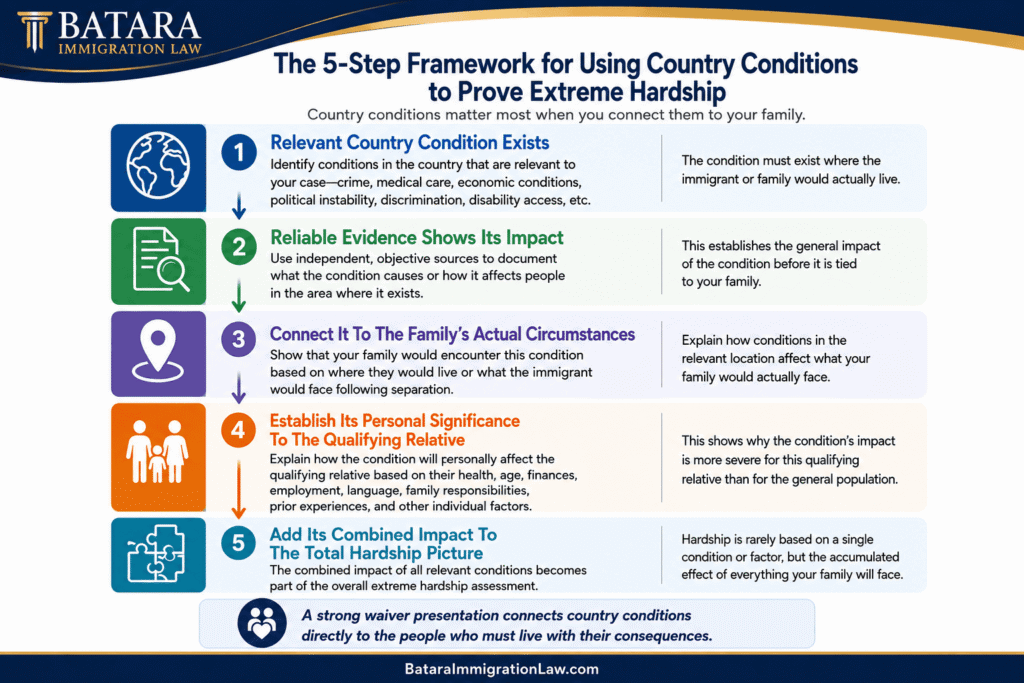
Country conditions are persuasive for I-601 and I-601A waivers when they are part of a family’s larger hardship story, not when they stand alone as facts about a distant place. Strong cases connect a condition, its evidence, and its effect on a specific family.
First, you have to show that a relevant country condition exists. Crime, inadequate medical care, unemployment, political instability, discrimination, limited disability access, or another condition must not only be present where the immigrant will reside, but also be relevant to the family’s actual circumstances.
Second, you need reliable evidence that demonstrates the impact of the relevant country conditions. Government reports, human rights and nongovernmental organization studies, specialized research materials, or other reliable third-party sources should document that the conditions exist, but also their consequences, rather than leaving them to assumption by the reviewing immigration officer.
Third, substantiate how the relevant conditions apply to the circumstances the family would face. An applicant’s evidence should be connected to the geographic location where the family will live, or to the immigrant’s circumstances following separation, rather than relying on broad national conditions that may not reflect the family’s actual situation.
Fourth, the qualifying relative has to establish how the relevant country conditions have personal significance. The discussion of issues like health, age, finances, employment, language, family responsibilities, prior experiences, or other circumstances must explain why each pertinent condition has hardship consequences for this particular family.
Fifth, the combined impact of these conditions is part of the total extreme hardship picture. Here, the analysis reaches its conclusion. In nearly all waiver cases, hardship is not based on a single condition or a single factor, but the accumulated effect of everything a family will face.
Country conditions are not simply a collection of facts about another country that have negative implications for a qualifying relative’s family. Rather, as the USCIS Policy Manual recognizes, they are important because they describe the environment in which a family’s separation or relocation will occur. A strong waiver presentation connects country conditions directly to the people who must live with their consequences.
In essence, the difference is between proving a country has problems and proving what those problems mean to your family. If you do this, you will take a major step towards winning an I-601 or I-601A waiver based on extreme hardship.
Reviewed by Carlos Batara, Immigration Attorney
Serving clients through our Hemet headquarters, throughout Riverside County and San Bernardino County, and nationwide through virtual representation.
Last updated: August 2026
If you would like guidance in evaluating or preparing your waiver case, let’s get started with a Personalized Strategy And Planning Session.