Hard immigration cases are not always lost. Hard immigration cases can be won. Prior denials, RFEs, NOIDs, or complicated histories can often be overcome with the right legal strategy, evidence, and preparation.
Led by Harvard Law School graduate and immigration attorney Carlos Batara, our office helps clients nationwide evaluate and pursue complex cases that may still be winnable.
Many immigrants are told their cases are “too hard” by others – attorneys, paralegals, and relatives. Past immigration violations, adverse visa, green card, or citizenship decisions, or border entry issues cause applicants to lose hope.
Through a secure virtual immigration law office, we take on cases other firms turn away – and work to keep your immigration aspirations alive.
What Makes An Immigration Case “Hard” — And Still Winnable
An immigration case is often labeled “hard” when it involves prior case denials, credibility concerns, missing or inconsistent evidence, alleged fraud, or a complicated personal or immigration history. These types of challenges frequently cause applicants to believe their case is over — even when legal options still exist.
Hard cases commonly include situations where USCIS or a consular officer issues a Request for Evidence (RFE), a Notice of Intent to Deny (NOID), or an outright denial based on how evidence was presented rather than on ineligibility itself. In other cases, problems stem from a client’s past filings, prior marriages, unlawful presence, criminal records, or gaps in documentation.
Yet, a case may still be winnable when the underlying law allows discretion, additional evidence can be introduced, or mistakes can be corrected through motions, appeals, or strategic re-filing. Success often depends not on starting over, but on identifying what went wrong, addressing the government’s credibility or evidentiary concerns, and presenting the case, once again, this time with sufficient clarity and proof.
How Hard Immigration Cases Are Evaluated — And When To Move Forward
Not every difficult immigration case should be pursued in the same way. Some matters require immediate action to preserve legal rights, while others benefit from careful preparation before any filing or challenge is made. Determining the right path forward begins with a detailed evaluation of both the case facts and the governing law.
The evaluation process for hard cases must consider risk. Certain actions can trigger unintended consequences if pursued prematurely or without adequate preparation.
Hard immigration cases typically require examining the reasons for the government’s concerns or denials, the strength and consistency of the existing record, and whether additional evidence or legal arguments can address the issues raised. This involves reviewing applications filed, interview notes, supporting documentation, and decision notices to identify where the case broke down.
In some situations, moving forward may involve filing a motion to reopen or reconsider, pursuing an appeal, or responding to a request for evidence or notice of intent to deny within a strict deadline. In other cases, the better strategy is to pause, gather stronger evidence, clarify inaccuracies, or wait until the grounds for legal eligibility improves. Timing, discretion, and procedural posture, in short, are often as important as the true facts of an immigrant’s case.
We Handle Hard Immigration Cases (Wherever You Live)
Hard immigration cases come in many forms.
- A denial from the U.S. Citizenship and Immigration Services (USCIS)
- An unfavorable ruling at their Immigration Court hearing
- A negative decision at an American Consulate office abroad
Faced with such adversity, many immigrants feel all is lost. Well, maybe it is. But maybe it’s not. This is why figuring out whether a successful challenge can be mounted is crucial.
When the going gets tough, after all, the tough get going.
Hard cases that can be overcome share one thing in common: the case did not fall short because the applicant was ineligible. Rather, the evidence, the legal framing of issues, or the procedural handling was insufficient or misunderstood.
Reviewed by Carlos Batara, Immigration Attorney
Serving clients through our Hemet headquarters, throughout Riverside County and San Bernardino County, and nationwide through virtual representation.
Last updated: May 2026
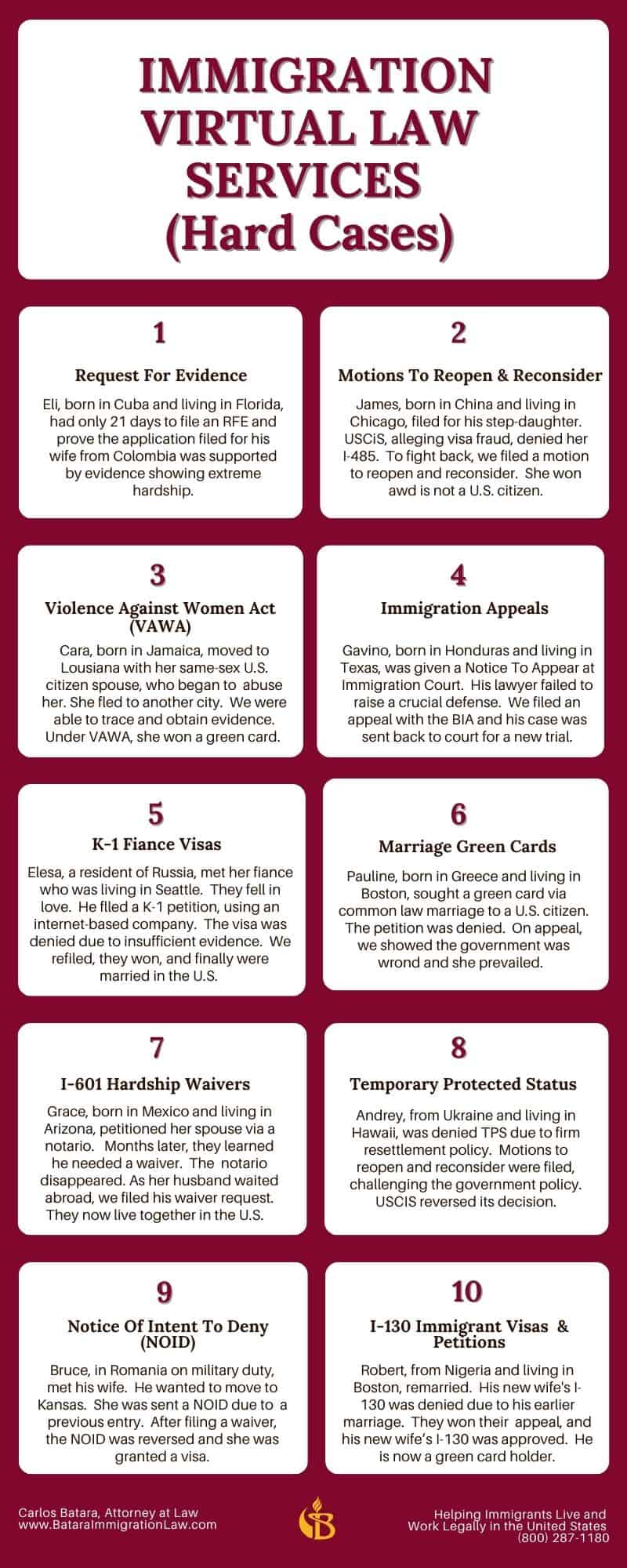
Representative Examples Of Hard Immigration Cases We’ve Handled
Representing immigrants and their families in difficult cases has been a core component of our services, coast to coast, for over three decades.
The following examples illustrate the types of complex immigration matters that may still be worthwhile to pursue when handled with careful legal analysis, strategic preparation, and strong supporting evidence. .
Requests For Evidence And Tight Deadlines
Eli, born in Cuba and living in Florida, had only 21 days to file a response to an RFE and prove the marriage green card application filed for his wife from Colombia was supported by evidence showing extreme hardship.
Here are some insights regarding how USCIS officers evaluate these notices and how to successfully respond to RFEs and Notices of Intent to Deny.
Motions To Reopen And Reconsider After Allegations Of Fraud
James, born in China and living in Chicago, filed for his step-daughter. USCIS, alleging visa fraud, denied her I-485. To overcome the government’s decision, it was necessary to file an I-290B motion to reopen and reconsider within 30 days. She won and is now a U.S. citizen.
Additional information about post-denial options and procedural requirements is available in our overview of motions to reopen or reconsider denied USCIS cases.
VAWA Self-Petition After Domestic Abuse
Cara, born in Jamaica, moved to Louisiana with her same-sex U.S. citizen spouse, who began to abuse her daily. She fled to another city. To prevail under the Violence Against Women Act, we had to trace and obtain evidence from the two other locations, in order to support her claims.
To learn more about eligibility, evidence and strategy in domestic violence cases, an overview is available on our page explaining VAWA self-petitions and immigration options for abused spouses and family members.
Immigration Court Appeal After Attorney Error
Gavino, born in Honduras and living in Texas, was given a Notice To Appear at court to face deportation charges. His lawyer failed to raise a crucial defense. He was ordered to be removed from the United States. We filed an appeal with the BIA and his case was sent back to court for a new trial.
For more information about appellate review and when challenging a denial may be appropriate is provided on our page discussing immigration appeals based on legal or procedural error.
K-1 Fiancé Visa Denial Based On Insufficient Evidence
.
Elesa, a resident of Russia, met her fiancé who was living in Seattle. They fell in love. He filed a K-1 petition, using an internet-based “Do It Yourself” company. Due to insufficient evidence, the visa was denied. We refiled, they won, and finally were married in the U.S.
Certain issues cause many couples to lose their K-1 cases. These issues are “red flags” for the government. Learn these issues and ensure you provide USCIS with convincing evidence that your relationship is genuine in our discussion of common red flags that lead to K-1 fiance visa denials.
Marriage Green Card Denial Involving Legal Misinterpretation
Pauline, born in Greece and living in Boston, sought permanent residence via common law marriage to a U.S. citizen. The government denied the petition. On appeal, she showed the government’s position was based on a misinterpretation of law.
Government officials often fail to recognize marriages that do not look “normal”. But the reality is that marriage does not fit into a “one size fits all” formula. An outline of credibility issues, evidentiary pitfalls, and common errors that can cause couples to face heightened suspicion is available in our guide explaining common mistakes that lead to marriage-based green card denials.
I-601 Hardship Waiver After Filing Failure
Grace, born in Mexico and living in Arizona, petitioned her spouse via a notario. Months later, they learned he needed an approved I-601A waiver at his consulate interview abroad or he could not return to the United States. The notario had disappeared. Meanwhile, her husband was stuck overseas. We prepared his waiver request, and he was able to return to his family in the U.S.
Winning I-601 and I-601A are difficult. Additional information of how hardship is evaluated and where these cases commonly fail is explained in our article about 50 questions immigration officers use to evaluate I-601 and I-601A waiver cases.
Temporary Protected Status Denial Based On Policy Error
Andrey, from Ukraine and living in Hawaii, was denied TPS due to firm resettlement policy. Motions to reopen and reconsider were filed, challenging the government’s policy. USCIS reversed its decision.
TPS is a program under constant political attack. Additional discussion of post-TPS risks and possible next steps can be found in our overview of options for permanent residence after Temporary Protected Status ends.
Notice Of Intent To Deny As Result Of Past Border Entry
Bruce, in Romania on military duty, met his wife. He wanted to move to Kansas. She was sent a NOID due to a previous entry. After filing a waiver, challenging the border officers’ actions, she was granted a visa to join her husband.
A Notice Of Intent To Deny means this is your last chance to straighten things out with USCIS before they formally deny their case. Learn more here about why you must respond to a Notice Of Intent To Deny.
I-130 Petition Denial Following Prior Marriage Issues
Robert, from Nigeria and living in Boston, remarried. His new wife’s I-130 was denied due to his earlier marriage where the previous petition was withdrawn due to divorce. He was accused of marriage fraud. After filing an appeal, his new wife’s I-130 was approved and he now owns a successful business.
For an in-depth discussion of why family-based petitions are denied and how credibility and evidence issues are evaluated is available in our guide explaining how spousal I-130 petition denials are evaluated and addressed.
Frequently Asked Questions About Hard Immigration Cases
Can a denied immigration case still be approved?
Yes. A denial does not necessarily mean your immigration case is over. Depending on the reasons for the denial, it may be possible to file an appeal, submit a Motion to Reopen or Motion to Reconsider, seek a waiver, or re-file with stronger evidence and legal arguments. The best strategy for challenging a denial depends on the facts, the law, and filing deadlines.
How quickly should I act after receiving a denial or adverse decision?
As soon as possible. Many immigration remedies are governed by strict filing deadlines. For example, motions and appeals often must be filed within 30 days, and responses to RFEs and NOIDs are subject to tight response periods. Waiting too long can limit or eliminate available options, so prompt legal review is often critical. Even when no immediate deadline applies, early legal evaluation can help preserve options and avoid costly mistakes.
What if I was told by another attorney that my case was impossible?
A second opinion may be worthwhile. Immigration law is highly complex, and different attorneys may evaluate the same facts differently. While some cases truly lack a viable legal remedy, others may still present options that were previously overlooked. A fresh review can help determine whether a realistic path forward exists.
What makes an immigration case “hard”?
An immigration case is often considered difficult when it involves prior denials, allegations of fraud or misrepresentation, criminal issues, unlawful presence, removal proceedings, prior marriages, or significant evidentiary weaknesses. These factors can complicate a case, but they do not necessarily make success impossible.
How do I know whether my case is worth pursuing?
The best way to answer that question is through a detailed legal evaluation. A thorough review can help identify the reasons the case encountered problems, determine whether any legal remedies are available, and assess the risks and likelihood of success.
Can prior attorney mistakes be corrected?
Often, yes. Errors by prior counsel – such as failure to raise an available defense, missed deadlines, or a poorly prepared evidentiary record – may be addressed through appeals, motions, or strategic re-filing. Whether a remedy is available depends on the nature of the mistake, the procedural posture of the case, and applicable deadlines. An evaluation with an attorney is usually critical in such cases.
Can a prior removal order be overcome?
Sometimes. Individuals with prior removal or deportation orders may still qualify for immigration benefits, but additional steps are often required. Depending on the circumstances, this may include filing a motion to reopen, seeking consent to reapply for admission, or pursuing relief in Immigration Court. The consequences of a prior removal order can be significant, making careful legal analysis essential.
Can a case involving fraud or misrepresentation still be approved?
Yes. Allegations of fraud or willful misrepresentation are among the most serious issues in immigration law, but they do not always end a case. In some situations, the government’s findings can be challenged directly. In others, an applicant may qualify for an I-601 waiver if the statutory requirements are met.
What if my immigration case involves a criminal record?
A criminal record can create significant immigration consequences, but not every conviction results in permanent ineligibility. The impact depends on the specific statute, the disposition of the case, and the immigration benefit being sought. Some individuals may remain eligible for relief or waivers.
Hard Immigration Case Assistance Throughout Hemet, San Bernardino County, And Riverside County
Facing a difficult or denied immigration case can feel overwhelming, especially when prior filings, government notices, or complex histories are involved. Not every hard case should move forward in the same way, and understanding your options requires careful legal evaluation.
Batara Immigration Law works with clients nationwide to help assess complex immigration cases, identify potential paths forward, and determine whether pursuing further action is in their best interests.
If your immigration case has been denied, challenged, or labeled “too difficult,” you owe it to yourself and family to find out if your case might still be winnable and, if it is, how to proceed responsibly.
We help clients with difficult immigration cases through our regional service hubs:
No matter where you live, we are committed to protecting your rights, pursuing every form of relief available, and keeping your family together.
How To Get Started
Ready to take a serious look at whether your case is still winnable . . . and, if so, how to proceed responsibly? Schedule your personalized strategy and planning session today.