My client, an immigrant from China, had been summoned to an interview with the U.S. Citizenship and Immigration Services (USCIS).
Prudence dictated hiring a certified translator to attend the appointment with us.
My client was only 30 – 40% fluent in English. I know 0% Chinese.

Back in my days as a political science professor, I would point out how candidates scapegoat politically powerless individuals for self gain.
Like undocumented immigrants.
Since they cannot vote, their ability to fight back is nearly non-existent.

Prior to April 1, 1997, Immigration and Nationality Act section 212(c) provided a waiver for certain lawful permanent residents who were rendered deportable by a criminal conviction.
But on that day, the constitutional promise of immigration due process dimmed, and deportation defense died.
Almost.
Left in a coma-like state by Newt Gingrich and his Congressional cronies, the concept of fairness in immigration law became a political farce, if not a national tragedy.
The implementation of the Illegal Immigration Reform and Immigrant Responsbility Act (IIRAIRA), as noted in Newt Gingrich: The Grinch Who Stole Immigration Reform, was intended to eliminate nearly every avenue of legalization for immigrants.
At the time, I was an immigration lawyer in Escondido. I knew we had officially entered the dark ages of immigration law. There was no turning back. The gauntlet had been thrown down. It was fight or flight time.
Among the casualties, section 212(c) of the Immigration and Nationality Act.
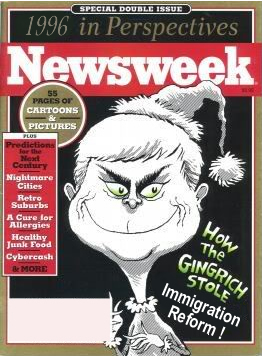
Newt Gingrich as the new savior of immigration?
Bah! Humbug!

When the idea of a deportation review panel was initially floated, I was skeptical it would get off the ground.
Now, given recent information shared by Janet Napolitano, DHS Secretary, in testimony before Congress, I think something resembling review panels will be implemented.
Otherwise, Obama risks further alienating immigration reform advocates at a time when his need for their electoral support is growing.
However, as a Riverside immigration attorney, I still doubt the panel will live up to its advance billing.

When it comes to immigration law, what the Obama administration giveth, the Obama administration taketh away.
In mid-August, the administration announced it would suspend deportations against undocumented immigrants if they did not pose a national security or public safety threat.
The statement omitted any references to lawful permanent residents.

Last summer I cheered when Padilla v. Kentucky was announced.
As a green card lawyer, I thought the Supreme Court had provided immigrants with a new weapon against unfair deportations.
Over the past 14 years, far too many lawful permanent residents have plead guilty to criminal charges without knowing the convictions would lead to automatic deportation from the U.S.

Immigrants need a Dirty Harry.
From coast to coast, ICE officials act as if they are above the law.
Although the goal of the “Secure Communities” program is to remove immigrants who have been convicted of certain serious criminal offenses, many immigrants with no convictions or only low level offenses, like traffic citations, have been targeted by less-than-compassionate ICE agents.
Stories of ICE’s callous approach to law enforcement, at times, resemble robotic seek and destroy immigrant family missions.

As I read news reports about the HALT Act, my thoughts raced to poor Desirée from the 1973 musical, A Little Night Music.
Repeatedly scorned by her sought-after lover, she lamented her misplaced loyalty.
Don’t you love farce?
My fault, I fear.
I thought you’d want what I want . . .
Sorry, my dear!
And where are the clowns?
Send in the clowns
Don’t bother, they’re here.
With the introduction of the HALT Act, the president is probably also wondering if it’s time to send in the clowns.

A few months ago, Illinois Representative Luis Gutierrez announced the “Change Takes Courage” campaign. The initiative challenged the president to exert leadership on immigration reform.
Sadly, courage and leadership are not traits found in most politicians. Their modus operandi is reactive in nature. If they feel a threat to their reelection, they start to adjust in accordance with the public winds of the day.
As a result, since far too many representatives lack the internal fortitude to push for change on their own, the public must externally provide the impetus for them to exercise such courage.